The Three Unspoken Problems in the Trans Community
What Plagues Us and Why Our Community Falls Apart

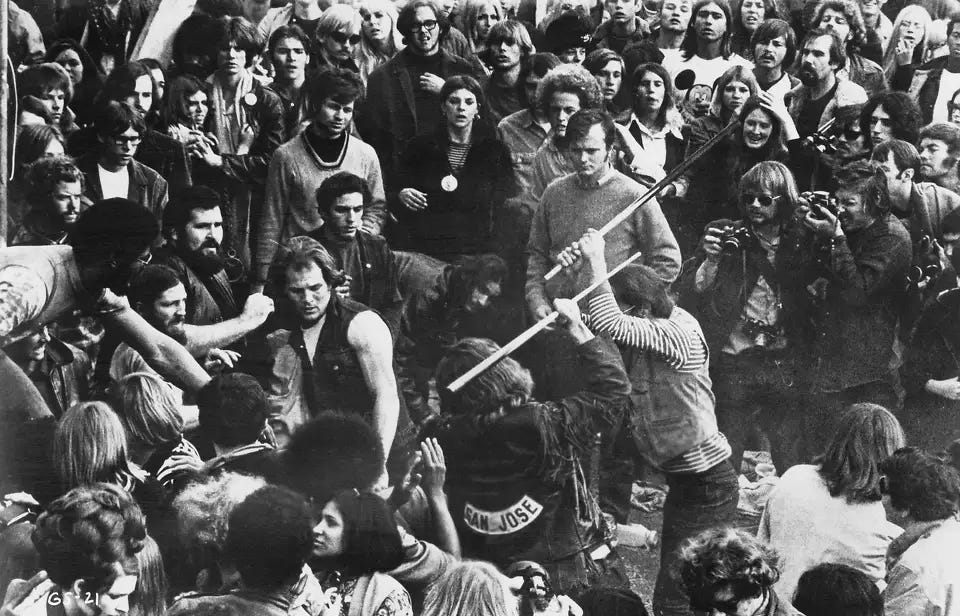
A still from the film Gimme Shelter (1970) of the violence at the Altamont Speedway Free Festival as the Hell’s Angels beat a music fan with pool cues.
Many people will read this as a commentary on, or a response to, certain high-profile drama within the transgender community. While current events certainly play a role in why I am choosing to write this now versus later, these issues are so ever present that by the time someone reads this in six months or a year (without checking the date of publication) they will probably think I am talking about yet another different scandal. The thing is, I’ve been in this community a long time, and I’ve seen these issues again and again, and had to learn how to navigate them myself. There are also a bunch of problems that play into the various upsetting behaviors of trans individuals, organizations, and communities that get plenty if airtime. So, I am not going to centrally talk about transmisogyny, cissexism, racism, assault, capitalism writ large, the tyranny of structurelessness, the panopticonic gaze of the right, or drug use and abuse. These are all problems within our community, but they’ve been talked about and will be talked about again (probably even by me). I am also definitely not going to talk about debunked ideas like transandrophobia or transmisandry. Instead, I want to talk about sanity, socialization, and success.
If you’ve been keeping up with my essays and posting you probably will have noticed a certain creeping nostalgia for the (often faux) hyper intellectualism of the late Trump 1 early Biden era. I think I come down firmly in the belief that everyone at least pretending to be body-positive and reading anti-racist anti-capitalist theory for fun was better than our current era marked by Ozempic-chic and a proud distain for doing more work than one needs to (for instance, by thinking/learning). Really what is at the heart of the difference between these periods is that 2017 through to 2022 was marked by a desire by anyone liberal to radically left to appear compassionate towards others. Often this compassion was skin deep, self-serving and self-aggrandizing, but at very least it was the aesthetic of the day. Since 2022 the biggest names in body-positivity have shed tens if not hundreds of pounds, AI has proudly rendered reading and writing a sucker’s game, and (to use the sort of implicitly racist language that in 2019 would have resulted in me having several callout posts written about me) what is left of the leftist queer community has largely circled its wagons and looked inward.
In addition to these two material changes (the marketing of Ozempic and AI), I think two additional factors lead to the downfall of the leftist theory spring. First, the genocide in Gaza showed two things to the then strong, inspiring, and fairly well-read leftist youth. Mostly importantly Gaza (and to a lesser extent BLM before it) revealed that sustained international non-violent mass protests led by even the most privileged1 of our youth cannot effect change against an entrenched regime hostile to change and willing to use force and to mobilize resources to out-wait even the most devoted to the cause. Secondly, it revealed that a certain percentage of the wealthiest activists within our community (especially those who grew up in upper-middle class whiteness) view activism as little more than a mix of model-UN and “works righteous” (to borrow from Luther). That is, in plainer language, it turns out that those of us who have never known real hunger or true financial insecurity often treat activism as a signifier of moral worth combined with a popularity contest. The contemporarily unparalleled horrors and atrocities of Gaza prompted many such people to suddenly drop their “deep commitments” and half-finished materially promising projects to become full time anti-Zionists, in doing so abandoning many at-risk queer and racialized communities. While I hope those activists did some real good for Gaza and did not merely appear for the photo-op then dip, their sudden evaluation of previous causes they’d claimed to care about left a bad taste in the mouth of anyone left behind. It is undeniable that Gaza needed and still needs whatever help can be mobilized. But real sustained mobilization from an intersectional lens means balancing new pressing issues while ensuring previous projects aren’t completely abandoned. This is actually good for the new pressing issue too, because sustaining the help you’re providing to queer, disabled, or racialized communities means that more members of those communities will have the bandwidth to show up to help fight the good fight of the new cause too.
The second additional factor that lead to the downfall of the leftist theory spring was an unresolved tension between the ACAB/prison abolitionist movement and the MeToo movement, both of which by 2020 were solidly blended into one intersectional movement. It was commonplace during that era to see the same person posting about cop/prison abolition one day, and saying “kill your rapist” the next. Now, of course, technically those statements aren’t in contradiction. Afterall, you do not need a cop or a prison if you are going to commit vigilante justice and slaughter your rapist in the street. However, since most of us are against The Purge style violence, this led to a sort of collective doublethink where a large amount of the community held both these truths as self-evident without examining the tension. There was never a serious attempt to examine the patriarchal, racist, and commodifying reason so many of us felt that rape was a fate worse than death. Perhaps such a reckoning alongside a more earnest attempt to listen and learn from our sex working sisters would have helped. Alas. Those of us who were serious about abolition also witnessed quickly how imperfectly “accountability” and other anarchist strategies at community-based justice functioned in practice. We witnessed that these strategies only really worked against those who were already mortified by what they had done. The unrepentant or delusional local creep largely just kept on what they were doing. Meanwhile the language of accountability quickly became a means to wokely yet often violently harass anyone with a platform who you personally disliked, while simultaneously a means by anyone with a platform to avoid consequences…they could just say they’re taking steps towards accountability we sort of just had to believe them and hope it was true. Very infrequently, did anyone actually post verifiable documentable proof of the steps they were supposedly taking (like going to therapy or getting sober). Often, both sides of this accountability spiral merely resulted in the exchange of social or monetary capital. To the outside observer, all of this must have produced an intense disgust reaction. I am sure it convinced many a young person that the world was morally bankrupt, that activism was little more than an aesthetic for a type of reality tv star, and that they should be looking out for themselves and only themselves. We now live in the world of the young people whose foundational moments were these cynical mindset inducing ruptures.
But so far, I have only spoken about broad social trends in leftism in general. I haven’t said why I think these issues hurt the trans community more than most. That’s where my three unspoken problems come in. These problems are ones that I believe play a large roll in why the trans community’s discourse is often so incredibly bleak, self-interested, cruel, and heartbreaking. At first I was tempted to answer that the reason our community is like-this is because we constantly have new people coming in (and people once they’re a few years into transition and need the community less, quietly leaving/stealthing). This makes us different from racialized or faith-based communities who tend to have members who grew up within the community and who are unlikely to leave the community. That is, there’s not a bunch of newcomers with no sense of history, and there’s elders to look up to. However, the gay and lesbian communities also have people join all the time and leave quietly (to marriage or monogamy in the burbs), so it has to be something more.
Sanity
We fucking love talking about our trauma. Holy fuck we love talking about our trauma. It’s taken for granted that each and every one of us has some fucked up shit we’re dealing with. We trauma bond, trauma date, trauma ghost and trauma dump. Despite this, we sure don’t talk about how insane we are. We talk about trauma as a marker of our suffering, often with a semi-implicit feeling that this suffering was somehow purifying or cleaning, rendering us innocent. We also talk about our trauma as an explanatory force. We say “Listen, I’m sorry, but cause of trauma I often do ______ and I’m sorry and I’m working on it.” And that is a lot more mature than the purifying conception of trauma, and honestly a really good thing to do. But we somehow very rarely make the jump, as a community, to viewing ourselves as collectively traumatized and what that means.
Many trans people I meet have some horrific shit in their background. A lot of us were abused as children, often as punishment for gender diverse behavior, but sometimes just because our parents, aunts, uncles, etc were fucked up and wanted to. Some of us talk about it, some of us do not. We also have a large autistic community, and it is my understanding that many autistic children are abused in childhood because their parents do not know how to properly treat such a child. These two categories get discussed often enough. Then there are the results of trauma: developmental trauma disorder, PTSD, C-PTSD, bipolar and borderline personality disorder. Additionally, there is a small yet very vocal portion of our community that identify as plural, that is, living with dissociative identity disorder. We are all collectively aware that these issues persist in high levels within the trans community. I am not particularly convinced that they are actually as much higher than they are in the general public (I mean, have you seen how members of the general public behave?). Instead, I suspect that as a community, partly because being trans requires a certain level of honestly with oneself and ability to self-assess, we are more likely to notice issues and seek out help. Regardless, we have all of these issues within our community, and yet we very rarely consider how to take them into account when assessing intra community conflict and resolution. Shouldn’t it affect how we materially and rhetorically structure our responses to community upheaval if we can safely assume that one or more persons involved is likely to be having a psychological episode?
Additional to the childhood trauma, there is adult trauma. We like to talk about this even less (unless its sexual). We love to talk about sexual assault. But we rarely talk about anything else. In my experience there are two kinds of trans people, those who were not socialized (more on this in the next section) and those of us who before transition had really fucking fucked up lives. Before I transitioned, I was a committed hedonist. I read Oscar Wilde’s Portrait of Dorian Grey when I was a teen and thought that Henry guy was correct and didn’t look back. I could get into the poverty and queerness that lead me to that, but I’m not going to bother here. The point is, I figured I would just do drugs, drink, and fuck until I died (preferably at 27). I’ve been sober (minus two minor one-day relapses) since I transitioned. And that’s about the worst you can say about pre-transition me. I was a drug addict and I did drug addict behaviors. Others I’ve met have much worse shit. I’ve had people admit to me all kinds of lives from before they came out. I know people who were cult members, muggers, biker gang members, murderers, living under the porch of a noted punk frontman and stealing his garbage, alt-right trolls, and in one instance, a devoted old school fascist, uniform and all. As a community we have to hope that these people have done the work on themselves that is necessary. We have to hope that they do not treat transition as a one-stop-fix-all for their fucked up former lives. But we do not have to trust that that is true. We can presume that there is some baggage left over. We can presume that it can take decades to fix one’s worldview and recon with what one has done.
Arguably, it is responsible of us to engage with our community under the presumption that no one involved in a situation has perfect or even relatively good mental health. We should engage with the same caution a good social worker would use. That doesn’t mean not holding people responsible. It means using communication tactics that are likely to work. It means striving to preserve life. And it means exercising caution when assessing the truth of various parties’ claims and speech.
Socialization
Okay, for this section I am heavily borrowing from a friend’s conversation to me. So hi K, if you’re reading this, thank you (K is not their name, just an initial I am identifying them with for the sake of anonymity). Back a couple years ago when the discourse of the day was male socialization I had a really productive conversation with my friend K. The conversation started with the idea of failed male socialization. For those of you unacquainted, the claim can be summarized as this: “There is a strain of transphobic rhetoric that claims trans women are more sexually dangerous/aggressive than cisgender women because trans women were ‘male socialized’ or ‘lived as men’ and thus still behave in the manner that patriarchy teaches men to behave in. However, this is untrue because while it is true that society attempts to socialize trans women as male, in actuality this socialization is unsuccessful, as you can plainly see by the fact that they are now women. As such, you cannot presume trans women have internalized the aggression taught to men. Instead, many trans women are scarred and traumatized from the attempt to socialize them as male.” In this conversation with K I was by and large repeating these talking points. Then K paused, as they are prone to do, and I knew something big was coming.
They looked at me very thoughtfully and said (and here I am paraphrasing), “I think a large part of the behavior of trans people in general, not just women, can be explained by the fact that so many of them weren’t socialized period. A big part of socialization is experiencing early in life, while your brain is still learning how to exist, the sort of conflicts and social situations that teach you how to navigate being harmed and harming others, being let down and letting others down. A large segment of the trans community hid from social settings throughout their childhoods. They stayed indoors, they had few friends, they did not join clubs, hang out after school, go on camping trips, confess crushes, or date. They’re adults who have minimal experience navigating social situations. They were not socialized. And now, they’re trying with various degrees of success to learn how to be human being in society. Many of them are attempting to learn this via the rules being taught to them by online discourse. That’s a horrifying way to learn. The stakes seem so high constantly. Every misstep is made to feel like the end of the world. They never got the chance to push a buddy over on the playground because he stole your Beyblade, or start screaming and crying because your friend cheated at double dutch. They’re not socialized, and the socialization they’re quickly picking up is fucking Thunderdome mentality. It’s a cage match to the death. Or it’s Lord of the Flies, a violent popularity contest for fuck knows what. You need to start presuming that many if not most of your followers do not know how to de-escalate a situation, how to judge their own motivations, or how to kiss and make up.”
I listened to K, and I think you should too. And if you are among those who didn’t get enough socialization, please know, I’m not yelling at you, I’m not trying to shame you. I see you and I hope you’re figuring things out. It’s possible, and the best advice I can give you is just to relax. Not everything is the end of the world, not everyone is out to get you. Most people don’t care about you, and that’s actually okay and kind of good. Within the trans community a lot of your peers are probably in the similar place to you. Just communicate that to them. Don’t be afraid. If you do not know how to calm down or how to react say “I do not know what to do” or “I do not know how to calm down.” Someone will listen, and someone might help. The shame you feel only reinforces the maladaptive behaviors that you’re picking up. You’re going to fuck up. It will be fine. Just try and think things through so that when you fuck up its hopefully on the more minimal side. It would be pretty boring if no one ever fucked up. Besides, fucking up is often 50% how you behaved and 50% how you were received. And how you were received has a lot to do with the baggage and various degrees of socialization the other person is bringing into the situation. Try to react with compassion. Hope that they will do the same.
Success
Almost no one within the trans community is as successful as you probably think they are. Even the “celebrities”, the ones who are actual actors and popstars, are relatively precarious compared to their cis peers. Most of them do not make the money you imagine them making. Many of them have either spent it on horrible coping mechanisms or just weren’t paid very well to begin with. I think the only really exception to this is people with intergenerational money. But yeah, the trans people you see on TV aren’t untouchable, they’re worried about bills and inflation too. It’s actually probably embarrassing to many of them how normal their lives are. Yet they’re separated from us because their faces are on TV, metro advertisements, record covers, etc. As a group they’re amongst the most terrified of losing clout and the most terrified of being used by others—because deep down they are hoping for genuine human connection.
Below them, are people like me. While the actual celebrities you see on tv etc aren’t the untouchable hyper wealthy elite you think that they are, and instead live more upper middle class lives, people like me (influencers, activists, authors, DJs, comic book artists, indie film darlings) are by and large working class within the trans community. Almost all of us have service/retail day jobs (additionally many of us do sex work). We’re more visible than your average trans person, but we don’t actually make more money than the average trans person. I remember once when it felt like the entire trans internet was mad at my Instagram page, a bunch of people started calling for myself and my co-authors to hire a publicist and an assistant to moderate our comment-section. It was insane. I laughed aloud. It was the first time I truly realized that people conflate visibility with income. Needless to say, I don’t have the income to hire staff. I don’t even have the income to pay myself a living wage.
Okay, I promised I wouldn’t talk about transandrophobia but I lied. I’m going to talk about it very very briefly as an example. A lot of transandrophobia activists claim that trans women are systemically more privileged than trans men because we are more visible in media and to the non-trans community. While there might be some truth to the idea that seeing something in media provides one the knowledge that it exists as a possibility, something you could become or be, this argument rests on the assumption that the version of you being shown in media is portrayed as desirable. In actuality, trans women are far more visible in media because we are far more villainized. As a result of our visibility, people are far more afraid of us, angry at us, and likely to violently assault us. Increased visibility without increased security is a trap. Yet so many people mistake visibility as a sign of security or wealth. On the individual level, that hasn’t been true for thirty years at least. Just because you see someone on TV does not mean they have money or bodyguards. It just means we’re more scared.
That experience helped me to realize a large part of the hatred that was being directed towards me, the stuff I really really couldn’t explain (for instance that me promoting the writings of Edward Said proved I was a Zionist) was just a deep desire to tear down whatever and whoever the trans community felt was too successful. Now, I’m by now means saying trans people with hyper visibility cannot severely harm the trans community. I think we can all think of some recent examples whereby platforms were used to commit a level of harm that personally emotionally devastated me. What I am saying is that after well over half a decade in the trans public’s eye I can say with certainty, no trans celebrity or micro-celebrity survives unscathed. We’re crabs in a bucket pulling down anyone who looks like they might be making a ladder out, even if that means our own perpetual entrapment. We’re envious and jealous of a material security almost none of the people we’re envious of actually have.
Worse, we’re not even sane or well-adjusted crabs. As far as crabs go half of us have not been socialized and don’t really know how to interact with other crabs, and the other half of us are a little bit insane from the shit we’ve experienced. How the fuck are we supposed to navigate visibility and community? And by that I do not mean “we visible ones” I mean the ones watching and reading the content just as much as I mean the ones making it. We gave up on accountability, but we kept the language of it. Where do we go from here? How do we keep ourselves from harming each other and our collective struggle? How do we trust and how do we heal? I’ve pointed to a few ways I think we can move forward. I think we need to start learning strategies used by social workers to interact with one another. I think we need to bring accountability back, but this time make it material by demanding proof (and not of monetary/clout reparations but of therapy receipts and other actual measures aimed at healing rather than shaming the person). I think we all need a little more rational skepticism towards people who behave irrationally and unpredictably. You do not owe anyone full and unquestioned belief. Maybe you owe hearing someone out and seriously considering what they are saying, but believing people can harm the person you’re believing in the long run. I guess what I am trying to say is this: we need to start treating each other as deeply imperfect while still working together to build something that valorizes not the individual but helps the community. We need to stop being terrified of each other, but we also need to learn how not to fully trust each other either. We need to escape that good-bad dichotomy and instead arrive at a productive and human middle.
I am referring here to the fact they were university students, obviously this aspect does not apply to BLM.