

The Second Lesbian Sex War
Against Liberal Sex

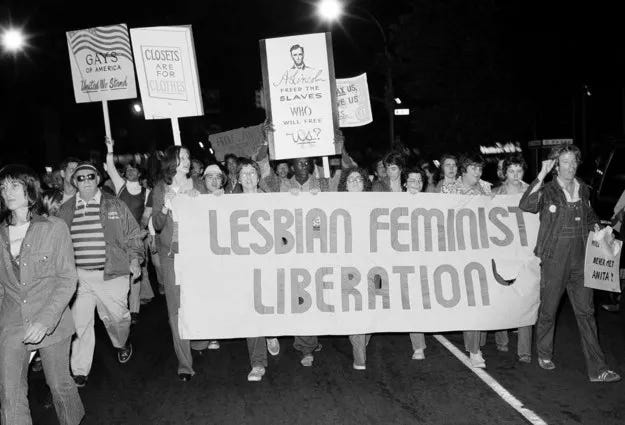
Dear fellow lesbians, I am restarting the sex wars.[i] Or rather, I am attempting to start lesbian sex war two, for I do not think the second lesbian sex war will have the same demarcation lines or the same alliances as the first. Some issues will remain the same, some will be dramatically different. In the 1970s the members of the women’s movement, then closely intertwined with the lesbian movement, ripped and tore at each other over issues including pornography, erotica, sex work, lesbian separatism, sadomasochism and kink. While rarely if ever physically violent, the lesbian sex wars erupted with such force that the debates and name-calling that comprised them is often credited with effectively ending the second wave of the feminist movement (allowing for the birth of the third wave). Many lesbians still re-debate the issues of the first lesbian sex war. By and large, these are not the issues I intend for the second to concern itself with. But, to put my cards on the table, here are my stances on the above issues:
· Pornography understood in its loosest terms is not inherently debasing, however, the contemporary pornography industry is by and large exploitative and violent towards women.
· Erotica, understood as fiction inclusive of sex scenes intended to arouse the reader, is a central part of modern women’s sexuality and while not above critique, far from inherently harmful.
· Sex work is exploitative and demeaning in similar ways to all other forms of work within capitalism. Due to its psychological and intimate aspects it may be more taxing on the worker than the average job, but is certainly less taxing than say military service.
· Lesbian separatism is a pleasant fantasy, but in reality, unworkable, defeatist, and reproductive of colonial mentalities.[ii]
· Sadomasochism and kink are legitimate forms of sexual activity, which, when done among consenting lesbian adults allow for creativity, exploration, potential healing, and may even allow for a more polymorphous sexuality, thus working as a bulwark against heteropatriarchy.
Given my understanding of these issues, it might surprise you to learn that in this article I will draw equally on 70s and 80s feminists on both sides of the first sex wars. You see, these 70s sex wars can largely be divided into two camps: liberally sex-positive and morally sex-negative. I am not a liberal, but I am sex-positive. I suspect that the majority of my readers are either liberally sex-positive or morally sex-negative. I also suspect that most of the liberal ones do not realize that they are liberals. Most of you probably call yourself socialists, or communists, or anarchists. You probably use liberal as an insult, not realizing you are one. We often use liberal as short form for “someone who supports liberal democratic institutions”. However, liberal is a descriptor there. It describes an aspect of the democratic institutions. You can also have illiberal democratic institutions (for instance the Islamic Republic of Iran holds various kinds of elections). Liberal is the word we use in political philosophy to describe when a state or philosophy abdicates its capacity to ascribe moral control or judgement upon individual ways of life. For instance, in 1967 when Canadian Prime Minister Pierre Trudeau proclaimed “…on homosexuality. The view we take is, there’s no place for the state in the bedrooms of the nation,” he was making a liberal statement. Likewise, when you say “desire is not political, let people fuck who and how they want to fuck” you are making a liberal statement. Meanwhile, when Andrea Dworkin wrote “I live in a country where if you film any act of humiliation or torture, and if the victim is a woman, the film is both entertainment and it is protected speech. Now that tells me something about what it means to be a woman citizen in this country […] When your rape is entertainment, your worthlessness is absolute […] The civil impact of pornography on women is staggering,” she was making an illiberal statement. She wanted pornography criminalized, to no longer be ‘protected speech’. She intended to interfere with the liberal rights of the individual to promote what she considered a collective moral good. Whenever you are promoting a collective moral good that interferes with an individual’s capacity to choose what is right and moral for themselves, you are making an illiberal statement. If you believe that society should be organized in a manner to maximize everyone’s freedom to pursue what they believe a good life is, then you are a liberal. If you believe that society should be organized in such a way to promote certain conceptions of what a good life is over other competing conceptions, then you are illiberal (what is sometimes called in political science, a perfectionist). Most modern western progressives are liberal. Increasingly, most modern western conservatives are illiberal, choosing instead to promote values like white supremacy, patriarchy, and specific religious beliefs. I am illiberal because I believe in banning those beliefs, and because I believe in organizing society in a way that promotes my beliefs of what makes a good society: art, a high standard of philosophic and historical education, media literacy, a legal obligation to take part in debates over political decisions, etc. My illiberalism extends to my lesbianism, and I am going to try and convince you that yours should too.
The idea that one can be an illiberal lesbian is hardly anything new. In her 1973 “Lesbianism and Feminism” Ti-Grace Atkinson defined ‘true’ lesbianism as a “commitment, by choice, full-time of one woman to others of her class”. She was very insistent that lesbianism required this sort of active commitment, writing that there “are women in the movement who engage in sexual relations with other women, but who are married to men; these women are not lesbians in the political sense. These women claim the right to private lives; they are collaborators.” Alison Jagger[iii] argued that heterosexuality produced in women a “fragmented consciousness” which made it “impossible for women to develop even their full sexual potential, let alone their non-sexual potentialities.” She added that “the problem of women’s sexual alienation is not just that women are not free to express their sexual preferences; more fundamentally, it is that women cannot discover what are their sexual preferences.” Sandra Bartky[iv] argued that women must produce a feminist consciousness in themselves by “negating and transcending awareness of one’s own relationship to a society heavy with contradictions,” potentially having to leave “her husband and children” to “seek independence and self-fulfillment on her own”. Bartky believed this would result in a woman who was “an outsider to her society, to many of the people she loves, and to still unemancipated elements of her own personality” but she could at least experience liberation. But don’t worry, my illiberal demands are not quite so extreme.
I am not demanding that you refuse all association with men. I am not even saying that you can’t be real lesbian if you sleep with men. Indeed, such a claim would run counter to my steadfast belief that we must love and support lesbian sex workers. I also have no issues with the concept of bi-lesbians as long as they are invoking the term lesbian to denote a commitment to lesbian-feminism. What I am trying to show you is that lesbians have over a fifty-year history of illiberal feminist thought. I also want you to notice that this illiberalism was not merely about defining who counted as a lesbian or what a good lesbian feminist’s relationship to society should be. Feminists frequently made claims about each other and the types of sex they were having amongst themselves was not beyond analysis. Diana Russel argued in “Sadomasochism as a Contra-feminist Activity” that lesbian kink activity was the result of “the internalization of heterosexual dominant-submissive role playing.” She goes on to insist, “I see sadomasochism among lesbians as involving […] an internalization of the homophobic heterosexual view of lesbians.” Tacie Dejanikus in “Our Legacy” asks “why should we let them [lesbians who do kink] get away with calling themselves lesbian-feminist?” Gayle Rubin in “The Leather Menace” retorted that “It will be a historical tragedy of almost unthinkable dimensions if the revived feminist movement dissipates into a series of campaigns against recreational sex”. She later adds that it “is sad to be having to fight to maintain one’s membership in the women’s movement when it is so imperative to create broad-based coalitions against fascism […that the] level of internal strife around s/m should be reserved for more genuine threats to feminist goals.” I have already made it clear that I believe kink belongs within the lesbian community.
The point, instead, that I am trying to make is that these questions of what the ethics of lesbianism are, including who and how we date and fuck, have been questions hotly debated by lesbians for well over half a century. I imagine that at this point you’re a little confused. If I’m fine with kink and sex work and erotica and porn then what on earth am I illiberal about? I do not care how we fuck. I think it is by and large perfectly fine to be liberal about how we fuck. It might interest you to know that in the 70s using a strap-on or a dildo was often considered a sadomasochistic act. I doubt any of us want to go back to those days. No, what I want to talk about is who we fuck. I’ll let you in on a little secret, in my experience Black lesbians disabled lesbians and fat lesbians are far more likely to fuck trans women than skinny white cis lesbians are. In turn, I, a trans lesbian, am far more likely to reciprocate their advances.
In her 1984 essay “Thinking Sex” Gayle Rubin argues that within the lesbian feminist movement a new hierarchy of sexual validity. I will reproduce her description of it almost in full:
“Within this framework, monogamous lesbianism that occurs within long-term, intimate relationships and does not involve playing with polarized roles has replaced married, procreative heterosexuality at the top of the value hierarchy. Heterosexuality has been demoted to somewhere in the middle. Apart from this change, everything else looks more or less familiar. The lower depths are occupied by the usual groups and behaviors: prostitution, transsexuality, sadomasochism […] all casual sex, promiscuity, and lesbian behavior that involve roles or kink or nonmonogamy are also censured. Even sexual fantasy during masturbation is denounced as a phallocentric holdover.” I think it is very telling that “groups and behaviours” are lumped together here. Trans people (a group) are placed alongside sadomasochism and prostitution (behaviors). It makes a lot more sense when one realizes that trans people are for non-trans people often a fetish. Just like you can be into kink, you can be into trans people. Or at least that’s what the porn categories imply. Likewise, although Rubin fails to note this, Black people, fat people, and disabled people are all also both a group and for many a fetish. Just as the shemale category exists for trans women and the ebony category exists for Black people, and there are feederism communities for people into fatness and disability fetishists are a well-known problem within the disabled community. If you are a ‘normal’ lesbian then, that is a white, skinny, able-bodied, cis lesbian, these other groups might have a rather lurid sexual association.
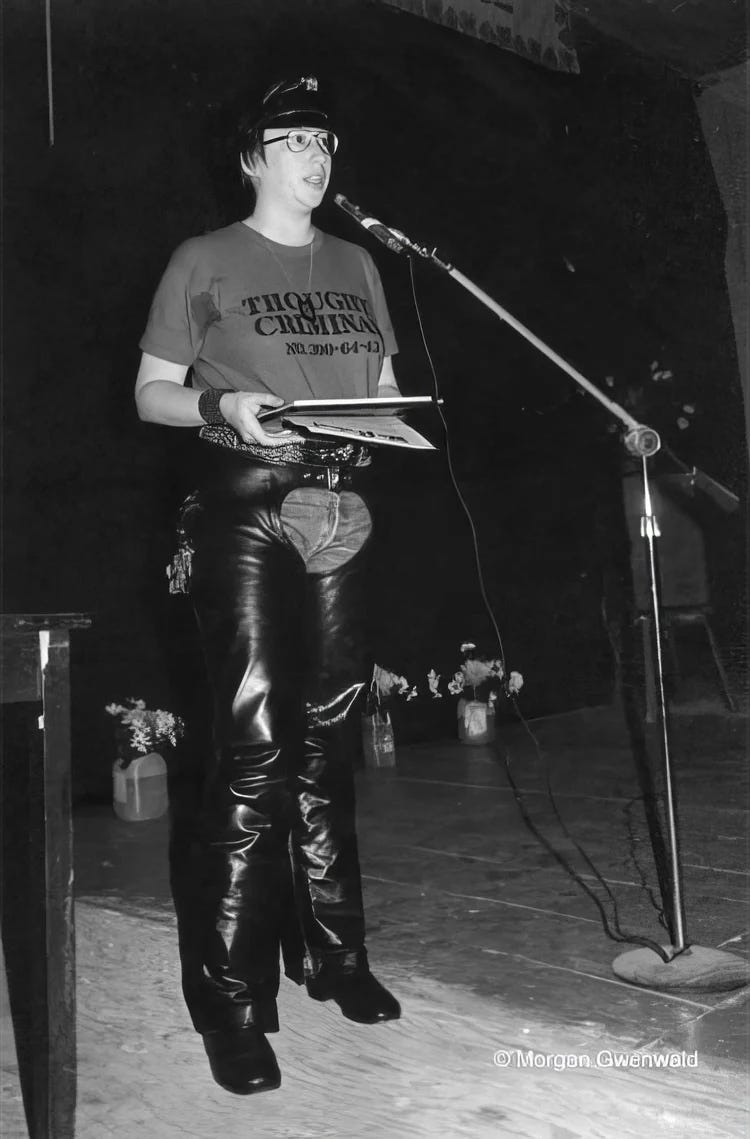
Gayle Rubin at a Lesbian Sex Mafia Speakout, 1982. (Image credit: © Morgan Gwenwald)
If you go to the average lesbian bar (at least the ones in my city), you will notice that the clientele is largely white, largely skinny, largely able-bodied (at least visibly), and while you will see trans women there, you will largely see them segregated from the otherwise cis clientele. The clientele likewise do not seem particularly perturbed by the lack of diversity, at least not enough to propose any changes to make things more welcoming. Sure, they all know about racism, fatphobia, and other prejudices, but there seems little concern that these structures have so obviously affected the demographics of the bar. I want to make clear that these demographics are not purely the result of lesbians’ dating and hookup practices. There are clearly more structural issues than this, but this is one of them.
Within my local scene, when these issues do come up in the discourse the most common explanations offered are ones of location and geography. The most popular of the three dyke bars in the city is “up two flights of stairs” (okay, then why aren’t the others host to more disabled populations), the bars are “in primarily in white neighborhoods” (as if lesbians aren’t willing to drive three hours to see their girlfriend, never mind metro twenty minutes across the city), the “staff is racist/fatphobic/transphobic” (as if the staff doesn’t reflect the clientele, as if the staff are the primary people one interacts with at a busy bar). Then there’s the ever-present myth, forever unproven and of which I am highly skeptical, that Black Canadian families are just more homophobic than white families, so their daughters come out as queer less. Given what I’ve seen of white Canadian families, especially when compared to my own experiences growing up in a primarily non-white city and coming out to my primarily Black family, I am perpetually skeptical that the average white convoy-supporting, conservative party voting family is somehow more chill.[v] If fat, disabled, Black bodies are missing from our bars, and trans women are relegated to islands of tables unapproached by the rest, than the problem must partly be the behavior of the clientele.
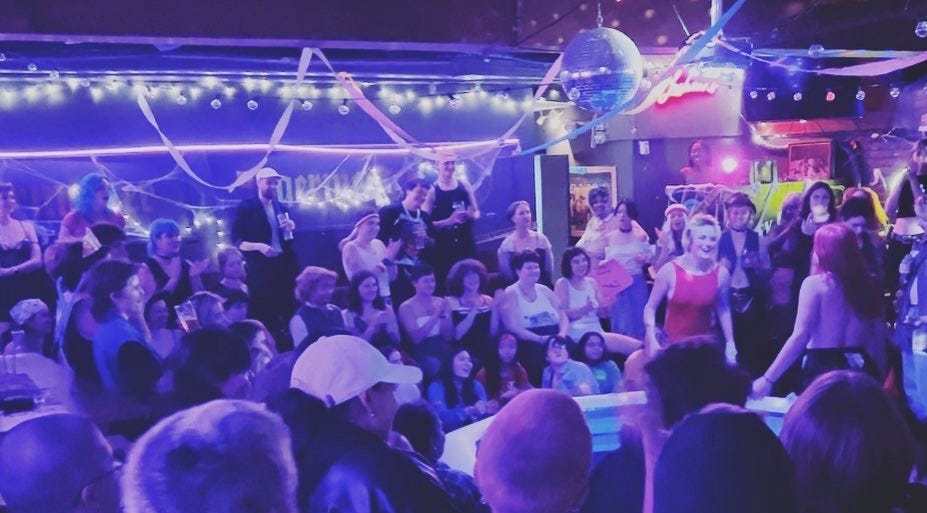
Champs bar, Montreal
Before I continue, I want to make a few things loudly clear. First, I am not telling any singular lesbian what to do. Second, I am not suggesting that any individual lesbian (aka you) sleep with anyone that she does not legitimately yearn to fuck. Third, these are systemic issues not personal issues. Just because I am not a liberal, does not mean that I consider you somehow obligated to change your sexual behavior patterns. I do not believe that you ‘owe’ sex to anyone. I do not view sex as a commodity that can be given.[vi] Likewise I do not view my fellow women as a commodity to be exchanged on a market, to be bought and sold, even metaphorically. We are non-possessable. Fourth and lastly, I am not arguing this for personal reasons. I’ve multiple partners, do not lack for hookups, and can stealth during hookups when/if I want to. This is a political commitment of mine, not a personal crusade. My attachments to it are emotional, not physical.
I want to suggest to you that who we fuck is political, as is who we are attracted to. Now, these two things are not exactly the same. Often, we are attracted to types of people we do not fuck. For instance, I really like men who look like Harrison Ford, but I’ve never slept with anyone even vaguely in that type of guy, they’re not exactly common among trans men. Likewise, many women unfortunately sleep with people they are not attracted to, whether that be husbands they no longer enjoy or clients who pay them (arguably these are similar things, at least Gayle Rubin would say so). When we are single, we rarely fuck anyone we are not attracted to. It does happen. Sometimes we are lonely and settle. However, by and large, we sleep with whom we are attracted to. I am not trying to increase that amount. Indeed, I am interested by the honesty that emerges from our unwillingness to sleep with people we do not find attractive. In my last piece I argued that “The sexual realm is one of the least susceptible to lying. If lying and politics naturally go together, sex and lying are the most unnatural of bed fellows. I suspect it has something to do with distance. When there is a great distance between people, or between one people and many, it is easier to lie. Lying only needs to be done then with your voice or maybe just your words. It does not have to be a lie to anyone in particular. The impact of it is not immediately felt. Meanwhile when it comes to sex the lie is skin in skin. That’s how close it is. To lie during sex, you must lie with your body, to your body.” For me, that people are willing to show up to protests to protect trans people, to end racism, to liberate the disabled, and will loudly tell you in the bar or the lecture hall that they have done so, that they ‘stand’ with these communities, but by and large remain desirous of white, cis, abled—normative—bodies makes desire and therefore sexual interest, the true tell of a community’s view of its internal membership.
Now, if our community was structurally different this might be different. For instance, you can hardly tell if a gay man is down with trans women by his sexual habits. Likewise, if ours was a business community we might be able to tell something by who gets hired, fired, and promoted. But the gay economy of the 80s and 90s is no more. The physical spaces tell us something about the community’s willingness to help or hinder the disabled community, but often this reflects bar owners’ priorities rather than the community that shows up. It is true we have many protests, but over my years in the queer and leftist communities I can tell you that what protests are talked about and shown up to has far more to do with trends and a Protestant desire to look righteous, rather than a reflection of anyone’s firmly held beliefs. Indeed, you will see the same people at protests for things with inherently oppositional theoretical underpinnings. What people tend to care about is suffering, and if it looks like they are fighting for an end to said suffering. Almost no one at any given protest can tell you what the beliefs or goals of the movement are beyond the slogans and beyond an end to pain and death. Do you believe in nations and their Heimat, or cosmopolitanism and no-borders? See what I mean? They’re rather contradictory, yet you’ve probably implicitly announced your deep-felt support for both over the years. That’s okay, your heart was in the right place. But we cannot take your appearance at protests or your repeating of slogans at bars as a sign of your genuine understanding or informed allyship.
Speech is an easy way to lie. Showing up to somewhere is a slightly harder way to lie. Neither necessarily betray a true internalization. Neither of them say anything about your soul, only how you wish your soul to appear to others. It’s Nathaniel Hawthorn all over again. We intersectional lesbians understand that your words do not mean safety. I think an interesting parallel here is with the Black community. During the Black Lives Matter protests two truths became widely accepted within progressive circles. The first was that America and much of the world was institutionally and structurally anti-Black to a violent and deadly degree. The second was the sudden adoption of the belief that all white people have within them some ‘internalized’ racism. Whether you like it or not, Robin DiAngelo did her best Camille Paglia in The Watermelon Woman impression and her book White Fragility became everyone’s coworker’s favourite way to process what they witnessed on their TV and phones. Now, there are a lot of very good critiques of DiAngelo and the white response to the murder of George Floyd and subsequent protests.
We could point out how individual donations/reparations served as Catholic indulgences to assuage the soul, or how inclusive and intersectional language changes took the place of actual material and structural demands, but what I want to talk about is how these protests ever so briefly returned us to Freud and a theory of the unconscious. Perhaps because people were reading Baldwin and Fanon again, or more likely because of bad books like DiAngelo’s, white people en masse became aware (or perhaps guilty) of the prejudices they had, ones which they now recognized informed their behaviour. Now, I would like to tell you that this fixed something, that they collectively sat with their anxiety, sustained it, processed it, and came out the other side better people. Unfortunately, most of them rushed to quick language fixes, performative space holding, HR trainings, and a dehumanizing anxiety when around Black people. However, what has stuck around is a belief that our actions, feelings, desires, and motivations are not always clear to us, and are often informed by a society that socializes certain prejudices into us from an early age. There is an unconscious and there is a subconscious. Eros and Thanatos are not colourblind. Our unconscious and subconscious are places with prejudices.
The lesbian sex wars of the last century spent an awful lot of time trying to determine how debasing it was to receive strap, whether dominant lesbians were mentally men, if it was okay to picture women while masturbating, and other neurotic applications of Freud. What these sex wars largely failed to consider was non-normative bodies, lesbians with intersectionally discriminated-against identities. Likewise, the white paranoia of the Black Lives Matter moment barely breached into sexual ethics. Sexual liberalism was simply too enshrined. The trans community, and specifically the trans femme community has begun very carefully to discuss the ethics of sexual attraction. In my essay “How To Be Sexually Normal” I mentioned Julia Serano’s discussion of “a study that discovered that images of two men kissing evoked the same heightened ‘physiological markers of disgust’ as did maggots. More interesting for our purpose is that the research found that this ‘disgust response occurred across all subjects’ including those who considered themselves gay allies.” I went on to claim that “many of the sexualized transmisogynist actions I’ve had to endure over the years from fellow trans people have been due to this disgust and the shame of it.” Unfortunately, these claims are rarely listened to within the queer community. When they are brought up, sexual liberalism is trotted out and the trans woman is strawmanned, regardless of the details of her sex life, into the position of an incel trying to force ‘real’ women into sleeping with her.
Yet even the most generous reading of this fundamentally misunderstands the situation. The problem is not a group of trans women trying to participate as full members of the lesbian community, while the rest of the members have only given them half-status. The problem is that trans women, like other intersectionally-identified lesbians are stuck between two different groups of people who make up the majority of the bar-going lesbian population: (1) lesbians who have not unlearned their prejudiced disgust response to non-normative bodies, an (2) lesbians who have not unlearned their prejudiced fetishistic response to non-normative bodies. Recently someone in my Instagram comments section insisted to another commentor (who was complaining about the fetishization of Asian bodies in fujoshi communities) said that the phrase ‘fetishization of sex” was contradictory. They wrongly believed that “fetishize” means “to make something sexual”. This is wrong. In a previous essay I argued that fetishism is best understood in its origins, as a term borrowed by Marx from anthropologists of religion. These anthropologists were interested in objects like statues becoming more than mere idolatry (images of a god) and instead came to be believed to be the god itself (most famously the golden calf in the Bible and Moloch in Metropolis). Marx believed we were doing the same thing to capital. The term then via Freud made its way into objects used for sex. For instance, leather is just leather, but when worn by the right person in the right way, wearing leather can become sex itself. The object ceases to be just an object and becomes more (and, in some instances involving degradation, less) than what it materially is. Likewise, when we fetishize a person, or more accurately an aspect of that person, that aspect becomes all-important and replaces the importance of the person as an individual.
By and large, fetishization was what the lesbian sex wars were about. They were debates about the fetishization of the phallus, of women, and of the ways in which women were fetishized as a tradable commodity, as capital, within capitalist-patriarchy. Sex was not just sex. Sex was something a father gave to a man outside the family that he liked in the form of his daughter. When women loved women, they had to obsessively control and argue about which activities they sexually and romantically took part in carried with them internalized beliefs about how to have sex with, how to trade, how to traffic in women. They wondered about things like if penetration was a psychological way of occupying another person like an invading army occupies a land. They wondered if female minds could be colonized by male ideas. They worried that when they masturbated to the idea of their coworker at the Wild Oat Café and Yeast Farm if they were doing something male, something degrading. If I have my way, and we get the Second Lesbian Sex War, Lesbian Sex War II, it will not be fought over such neurotic and self-flagellating grounds. I do not care if you like the strap, or for that matter if you like to tie women up, if you like to see people bleed under you. If I want you to have any neurosis at all, any flash of guilt, I want it to be when you realize that all your girlfriends have been cis, have been white, have been skinny, have been non-disabled. Alternatively, if that is not true about you but you see a trend, say towards trans women, I want you to wonder why. I want you to question if you’re trying to reproduce heteronormativity with them, if you see them as effeminate men, if your breeding kink overvalues penis and does not value strap.
The lesbian community has too much sex-based shame of the wrong type. We define ourselves by our yearning, by our desire for the unavailable, to hide that we are still afraid of our sexual urges, still afraid like the way they were in the 70s that somehow our lesbian sex makes us ‘as bad as men’. Paranoid of causing harm, of behaving in the patriarchal way men do, we hit on people less, we have less sex, we voice our desires less, and we don’t explore the kinks we are curious about. Meanwhile, we seem to broadly lack the sex-based shame we should communally have. Why have you and none of your friends dated a trans woman? Why have you never slept with a Black woman? Why do you consider it impossible that the women in the wheelchair over there is a horny dyke? Why do you have lots of fat friends but never so much as kissed a size twelve? I am not telling you to go out and do anything you’ve no desire to do. But I am asking you to reflect on that lack of desire.
Before I transitioned, I told my therapist that I was really afraid of never sleeping with a cis woman again, of being relegated to T4T. It felt like I wouldn’t really be a real woman if the only people who saw me as one enough to date me were also trans women. I was bi and I knew I was fine with penises, but the idea of one on a woman freaked me out. I wasn’t against it per se, but there was a worry that I was trying hard to supress. It wasn’t that I found it disgusting, but I did not know if it would feel easy, normal, casual. I was paranoid that if I slept with a trans woman I might not be into it. I was worried that my uneasy truce with penises in general would translate to not being that into it when I did sleep with a trans woman. Or, what if I accidently treated her like a man because of it? I had all these paranoid anxious neuroses. Then I slept with a trans woman and I instantly realized that it was shockingly the exact same psychologically as sleeping with a cis woman. I wasn’t sleeping with a penis, I was sleeping with a woman, a person, an individual. I got over it and over myself.
I am restarting the lesbian sex wars because it is time we collectively get over our hangups. It is time we stop pretending that desire and sex are apolitical. It is time we get rid of shame, that we begin to identify lesbian desire with fulfillment rather than yearning, that we stop being so afraid of the wrong things. It is time to unlearn the passivity that is forced onto women starting in childhood and begin to be active beings who pursue what we want and are comfortable with why we want who we want. Death to liberal lesbianism. Long live socialist lesbianism. Join me, my sisters, you’ve nothing to lose but your prejudicial chains. Seize the means of desire. Stomp down embarrassment. Admit you’ve got psychological problems and join in the solution. Lesbians should be the happiest people on earth, for we need not men. Lesbians can be the happiest people on earth, as long as we learn to love each other.
[i] To some extent Amia Srinivasan restarted the sex wars in 2021 with the publication of The Right to Sex. However, I think the book, partly due to its analytical philosophy and analytical ethics framework was unable to frame its questions in useful ways, often accidently distorting reality with analytical jargon.
[ii] For a prime example of the interplay between colonial and lesbian mentality see this book by Dworkin: https://en.wikipedia.org/wiki/Scapegoat:_The_Jews,_Israel,_and_Women%27s_Liberation
[iii] This is from “The Politics of Socialist Feminism”
[iv] This is from “Phenomenology of Feminist Consciousness”
[v] I want to be clear, I am Jewish and my skin colour is white. I do not want it presumed that just because I was raised in a mixed household and that most of my extended family is Black that I am mixed, as I do not want to risk digital blackface.
[vi] Unless we’re talking about Rubin’s analysis of kinship systems creating patriarchy.