The Trans Perfectionist
or: the hot guy to loser lesbian pipeline

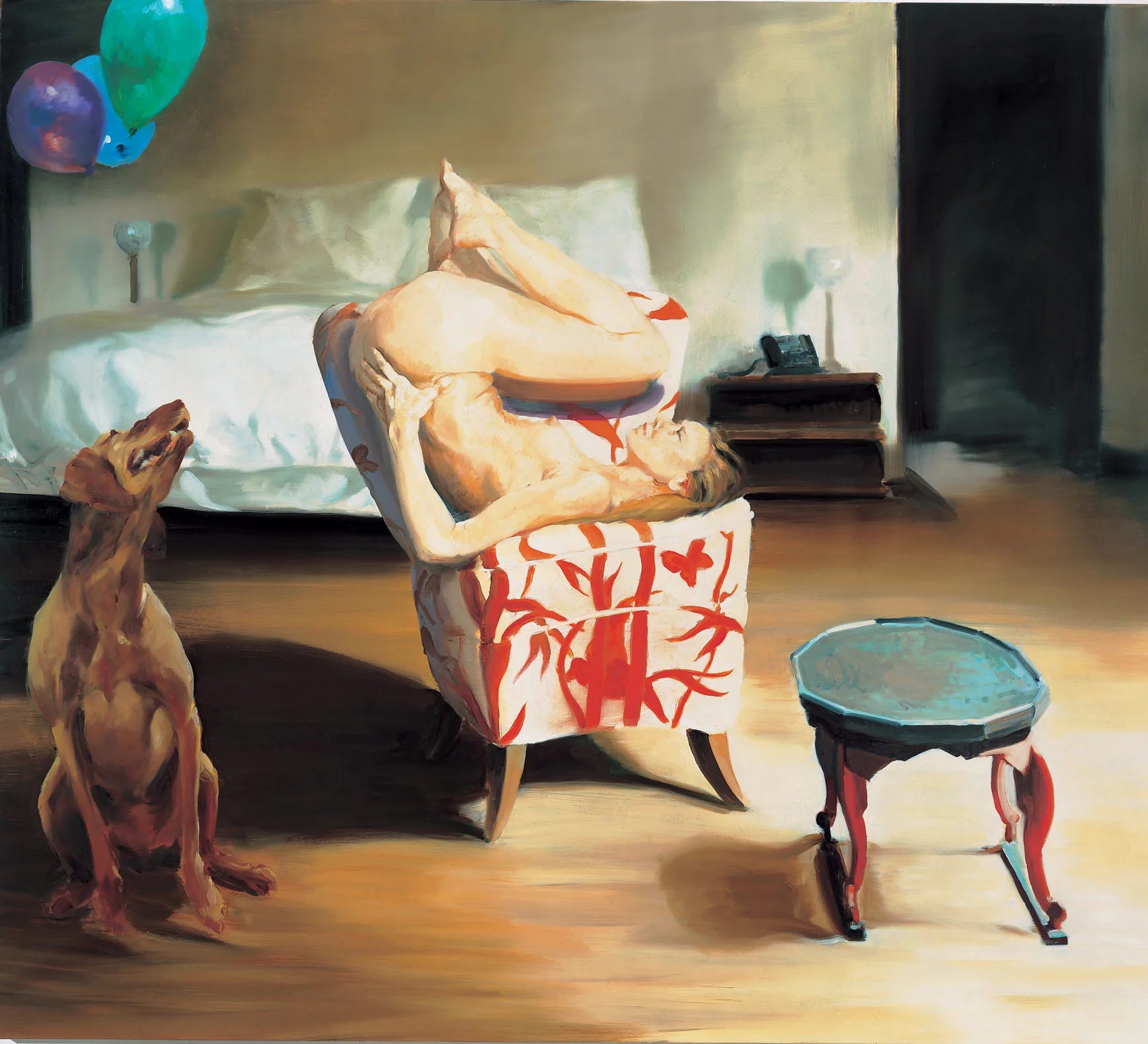
Eric Fischl, “The Bed, the Chair, Waiting” (2000)
I’m a little nervous about this. I’ve never been quite so diarist about my transition.[i] Unfortunately, this story is ultimately a personal one, and I will have to divulge more than I am typically comfortable with to do so. I wouldn’t go as far as to call this a tell-all, but it’ll be a tell-some which is a lot for me. The story I want to tell is about me but think a lot of people will recognize it in themselves, if perhaps to a lesser extreme. I am a trans perfectionist. Thalia Vacha recently wrote a piece on loser lesbians (and cool lesbians, and slutty lesbians, but really mostly about loser lesbians). In it she suggested that “trans lesbians are loser lesbians by default, by virtue of the fact we have a tenuous status in lesbian spaces. Some people hate us and some fetishize us and some take advantage of us. People with small dating pools can be easier to take advantage of. If we finally manage to get a date, we might be more invested in making it work than the other person.” Throughout the essay, Thalia makes clear that she finds something liberating in her loser status. I cannot relate. I like control. Ultimately that is what made Instagram (and now substack) desirable platforms for me. They’re not democratic. Unlike Discord, Bluesky or Tiktok (each in different ways) they do not blur the line between producer and consumer of content. At the end of the day, it is my page and I have control. I feel secure in that. Safe even.
That is how in approached transition too. I’ll be honest. I was a hot guy. I had a strong jaw, pretty eyes, and a carefully toned body. I knew about wine, spirits, good food, fashion, music, and cinema (but was obsessively careful not to mansplain any of it). My favourite movies were Wong Kar-Wai’s In The Mood For Love and Abbas Kiarostami’s the Taste of Cherry. My entire aesthetic promised a young man who was masculine yet dignified, with just enough of a dark past to add a thrill. When I was twelve, I told my mother that I thought girls were far more beautiful than boys and that it did not seem fair that I was one. I said I thought it would be nicer to be a girl. I asked my mother if everyone felt that way. She assured me that yes, even gay men agreed women were far more aesthetically pleasing than men.[ii] Heartbroken, but relieved it wasn’t just me, I stared into the mirror and told myself that if I could not be a girl, I would be the most attractive man I could be. By the end of my early 20s I had more or less achieved this. It did not satisfy me. Worse, age was beginning to threaten what I had worked so hard to achieve. Dysphoria was creeping in. Being a hot guy was not nearly a sufficient second place prize, and while life as an effeminate young man was one thing, the horrors of being a man (minus the young) sent me nightly to the bathroom mirror to obsessively check for signs of hair recession.
I had begun devouring feminist literature. The picture it painted of men did not teach me how to be a better man so much as it left my mouth full of disgust towards my supposed fellow men. An active bisexual, I had at that point experienced sexual assault by both men and women, but it was men my brain latched onto as the perpetrator extraordinaire. It did not help that the media firestorm that years later became the MeToo movement was building momentum after Rowan Farrow released an article reminding the world of Woody Allen’s sexual assault scandals on the same day the director was set to receive the Golden Globe Cecil B. DeMille Award for “outstanding contributions to the world of entertainment”. For those of you too young to remember, this article reignited a firestorm debate around the power of famous men, pedophilia, the infantilization of women, women’s un/comfort, and ultimately around sexual assault. Until that moment, as a bookish Jewish ‘man’ too young to remember Allen’s 90s allegations, I had been a fan. I felt betrayed. This betrayal alongside the honestly and frankness with which women began to speak about their fears surrounding men sent me reeling. Most of my friends were women, and I began to obsess over the idea that my well-meaning and benign foppish bi-twink existence was having a hitherto unknown sinister impact on those around me. Soon I could barely stand to be around women for fear that they might be afraid to be around me. The dialectic of being both a repeated victim of sexual assault and by nature of my apparent sex an archetype of the ever-looming threat of sexual assault tore me apart.
I wish that I could tell you that I am confident that these two factors (age worsening preexisting bodily dysphoria, the social dysphoria that evolved from a feminist consciousness) would have been enough to ensure my transition. However, I cannot promise that that is true. There’s a possibility that if I had reached these breaking points five to ten years later or earlier, I wouldn’t’ve transitioned. You see, I spent ages on Susan’s Place and other equivalent websites trying to determine if I would pass, if there was ‘still hope’, if I would be pretty. I determined that my height was okay (5’9”) and that all else was potentially salvageable. I also kept a really close eye on the media, on politics, to try and determine how things were going for the trans community. Had I not decided that I could pass, and had things not looked so sunshine and roses for us post-tipping point, pre-backlash, I’m not really sure I would have had the guts. To every trans woman who came out before 2014 and after 2020, I salute you. I’m pretty sure you’re braver than me. Yes, the stars had to align for me to risk it all, because, really, I wasn’t ready to risk it all. Knowing what I know now about trans life, I would transition again in a heartbeat, in a much worse political climate. But I did not yet know about the joys. All I knew is that if I was going to be a trans woman, I had better be a damned good one.
You see, I’ve never really hated myself. Most trans women I meet have hated themselves. Not me. I’ve thought myself ugly, cruel, selfish, mean, and other nasty words. I’ve even worried if I was somehow ontologically evil.[iii] But I have never hated myself in the way so many trans women do. I’ve never carried hatred of myself around with me. I’ve never worn self-hatred like a puffer coat. I’ve never wanted anything bad for myself. I’ve always hoped to live comfortably and happily alongside those I love and who love me in return. Not once have I questioned this hope, nor felt myself undeserving of it. I’ve never had a particularly inflated view of what I deserved either, but I at least always believed I should ideally be happy. Transitioning to join a group that until very recently was near universally mocked and scorned seemed a pretty big risk to this whole happiness thing. But then, so did mirror-blackening dysphoria and my increasing and rabid hatred of a patriarchy I found that I could not help but somehow reinforce. Still, if I was going to transition, I was going to be good at it.
What exactly it means to be good at being a trans woman is a great question. For me it meant some combination of attempting not to lose too much social status by becoming good at a variety of feminized things, at being a good woman, while also never being apologetic or ashamed of my trans status. I learned all that I could about women’s fashion, including its history. I read as much feminist and especially transfeminist literature as I could get my hands on. I figured out how to do makeup and I started watching movies and television aimed more specifically at women. I devoured confessional style books and articles about what it was like to be a modern woman. I (temporarily) quit academia for an office job (where I boymoded) so that I could afford a new wardrobe and some facial feminization surgery.[iv] I submitted myself to a brutal new workout regime designed to accentuate more feminine muscles which at its height had me at the gym for multiple hours seven days a week. I watched what I ate and watched the body language of other women to help exorcise masculinity. I was careful to change my wardrobe slowly and to never let it get so feminine as to accentuate by comparison any ‘masculine’ area I was concerned about. I was careful to maintain past hobbies and interests so that no one would accuse me of being a completely different person. I got therapy to try and manage my emotions through it all, and I sought out other trans women to befriend and learn from.
By and large I succeeded at all of this (although makeup remains an insecurity more often avoided than not). I’d made myself about as acceptable a trans woman as I possibly could be. Okay, there were a few outliers. I was a top, and I was known around town as a dom. I was also (and remain) polyamorous. Additionally, I was not into cis men, and into cis women. Yep, I was part of the good ol’ bisexual to ABCD (anything but cis dudes) pipeline. Still, I was successfully a polite, mild mannered, over-educated, pretty, thin girl, who usually benefited from white privilege and could perform being from a class she’d never once been permitted entry into.[v] So, what did I learn from all of this?
Now, I will never go so far as to say I tried to be ‘one of the good ones’. I was always loudly and aggressively transfeminist and will remain so until the day I die. Instead, what I think I did was try to be beyond reproach. I wanted to minimize any chance that the reason anyone disliked me or mistreated me was because I wasn’t living up to their ideals. I did not want anyone to be able to say “oh she’s ____” and have any shred of a leg to stand on as an excuse for cruelty towards me. I think it would have eaten me up inside, second guessing if they were right, if I actually was too ____ or, for that matter, not ____ enough. I was proud (still am). I did not want to spend my life wondering fearfully if what people said about me was true. I did not want to spend my life having my self-confidence whittled away by nagging worries over some flaw someone insisted I had. Sure, I’m far from perfect, but the flaws I have are flaws that I can live with having, that I do not think make me unlikable or unreasonable. I thought I could do my best to maximize my reasons to be successful and minimize the compounding fact that I’m a trans woman. I thought that I could still succeed at life.
My first rude awakening was professional. That office job I had secured to fund my early transition went up in flames. I outed myself and soon the transphobia was coming in from all sides. Half the women in the office seemed convinced that they had a predator living in the office, sure that my small talk about documentaries I was enjoying, or novels (Small Beauty, Infect Your Friends and Loved Ones) I was reading were really highly sexually inappropriate come-ons. Apparently suggesting to your colleague who works on HIV policy that she might enjoy Netflix’s Circus of Books (a charming documentary about a heterosexual couple who inadvertently become important during the AIDS Crisis via a queer bookstore they own) is enough to get you threatened with an HR complaint. Increasingly my boss viewed me as a problem to manage. I begged for a gender-neutral toilet so I wouldn’t make anyone uncomfortable and was told to use the café across the street. I begged for office-wide training on trans issues only to have to organize it myself and for my boss to cancel it last minute.
I ran back to academia. Afterall, I had been a golden boy in academia. My master’s thesis had been award-nominated. It was praised for providing genuine insights and furthering the field. I went on to publish large sections from it. When I spoke in class everyone stopped to listen. Professors thanked me for my insights. To this day I still get lunch with several professors from my master’s. It was something I was good at, something I felt confident I could succeed at, something I truly and passionately loved. And I wasn’t an idiot about it. I was careful. I asked my former supervisor who he knew that was trans-safe, trans-friendly around who worked in similar areas to me. He gave me a list of names he trusted and I emailed them. Eventually, I decided upon a prestigious school where multiple professors were known to be trans allies with close trans family members. I applied and got in. Then I was once again rudely awakened. Within the first year I was nearly completely ostracized from the graduate student body. There was no explanation. It wasn’t needed. I hadn’t done or said anything wrong. My feminist talk quickly got my labelled a man-hater, a killjoy, even among the women. People openly told me that they thought I didn’t like socializing or making friends. Really, I just didn’t want the men to treat me like a man, and I didn’t want the women to treat me like either a freak or their gayboybestie. I wanted to be seen as me and talked to like a peer, a friend one could get to know. I was stuck in a place where if I talked openly I began to see the same trans-panic in the eyes of my graduate student colleagues that I had seen in my former coworkers’, but if I did not talk openly I was accused of being tight-lipped or stuck up.
Among my professors, gone was any assumption of intelligence, of even basic literacy.[vi] I spoke increasingly less often in class, and was spoken over far more often. My insights were rarely processed for long enough to be considered. Help felt largely absent. I complained to one professor about a sexist remark a student had made to me (about my voice being too feminine to understand, whatever that means) and she retorted that I was “still new” to womanhood and needed to learn how to make male students respect me. Increasingly among my professors I learned that whenever I stood up for myself it was a sign of my “intractability” and whenever I did not, it was a sign that I was too feminine, too docile, not involved enough. I was being asked to do the task of welcoming myself in, because no one else would welcome me, and then I was being scorned for entering uninvited. Almost no one bothered to tell me when my ideas were bad or wrong. Instead, my work was called unreadable, too dense. I was told again and again that I did not know how to write in a manner that a mass audience could understand (often by people who knew very well that forty thousand people read my work online). At one point a professor of mine simply called it “not philosophy”. I did my very best to edit the work to their liking, but I was never quite sure exactly what they wanted or how to make it work. Meanwhile, fellow trans academics and grad students I’d met at conferences or around the city insisted my work was important and urged me to publish it so that they could cite it in their own work. I did not know what to do. If I complained I was considered stubborn and rude, if I came to them crying I was told that they had to step back to manage their own emotions, if I stayed silent my work slowed to a crawl and I ran out of money.
I started doing sex work. I needed money to sustain the snail crawl of my PhD. I had run out my savings from the office job. Thankfully, that seven days a week exercise regime had paid off (as had estrogen) and I now had the type of body that got one compared to Sarah Connor (of Terminator fame). This itself was rather alienating. I had wanted to be pretty but I wasn’t prepared for the sort of drooling many men permitted themselves. It was weird being commented on like I was not there. It was weird the way this positioned me to other trans women. I did not like walking into depanneur with a girl I had a crush on[vii] only for the man behind the counter to tell her, “You’re a lucky man to have a girl like that”. I began to understand why so many very pretty girls I’d known over the years had such quirky personalities, seemed so detached from their bodies. I was growing pretty detached from mine. But I’d discovered that my body was in very high demand among cis men and trans women. It isn’t great, and I don’t really want to say more about it than I absolutely have to, but I have tried to reassure myself that this far too often is how women sustain themselves economically through grad school, and that I have an out, that as long as my professors do not find out I will not be blacklisted. Besides, finally, all my desperate attempts at being the perfect trans woman had paid off, I was perfect for sex work.
The last thing I learned was who did not want my body. I was fashionable, tall but not too tall, a face that got compared to Jennifer Connelly’s and a carefully toned yet feminine body. I knew about wine, spirits, good food, fashion, music, and cinema. I was polite and mild-mannered while still seeming a little worldly. I was a published academic who lectured internationally and could speak to current political and cultural trends when asked. I drank socially, but rarely too much, sober from all other drugs but wasn’t vocally prudish about them and could be a good time at a party when needed. I’m not saying any of this to brag. Clearly there is something wrong with me. Multiple people have told me I approach life with such a perfectionist streak that they’re amazed they haven’t heard me break into the ‘cool girl monologue’ from Gone Girl. Except, I’m not some fantastical villain, the product of male fears about female agency. I’m a girl who is terrified, constantly, and rightly so if you look at the stats, of ending up in severe and inescapable poverty, un-hireable due to my transness, due to the sex work I’ve had to fall back on. I’m terrified of being trapped, of losing it all, of hating my life, of dying alone, of killing myself, of killing myself alone. So no, I am not telling you how hot and sexy and smart I am for your praise.
Instead, the point I am trying to make here is that I did everything ‘right’ or at least as ‘right’ as I could and still transphobia and transmisogyny have made things pretty near impossible for me. Right now I want nothing more than to finish my thesis, appease my supervisor, and try and find some financial security that does not depend on my sex appeal. Instead, I’ve been dating. I do not know what to do professionally. I guess I am giving this writer thing its all. I’ve got a second book ready to go should someone want to publish it. But that involves waiting too. So right now, I’m dating. And in dating, I am once again being taught who does not want my body. I opened this piece with Thalia Vacha’s suggestion that “trans lesbians are loser lesbians by default, by virtue of the fact we have a tenuous status in lesbian spaces. Some people hate us and some fetishize us and some take advantage of us. People with small dating pools can be easier to take advantage of. If we finally manage to get a date, we might be more invested in making it work than the other person.” And recently, I’ve learned this yet again the hard way.
I’ve tried really hard not to be a loser lesbian. I mean, I’ve spent this piece documenting precisely how I went about trying to be as pleasing as possible. And transbians, bless you all, you’re so wonderful and without you I think I would be in a much worse place. Because what I’ve learned is that you can be so hot that cis men beg to fly you across oceans and offer hundreds of dollars for panties you wore once, but the majority of the sapphic community will not consider you an option if you’re a trans woman. There are some cis women who are trans chasers, but most of them aren’t interested in me since I’ve had bottom surgery. I’m also largely uninterested in them since I like being treated as more than naturally warm dildo. Then there’s the majority of cis lesbians, who just presume you have a penis or are icked out by the idea of your chromosomes or some original sin or whatever. They have blinders on that exclude you. I also am not particularly interested in dating them, since in my experience, the majority of them who will date you expect you to be chivalric (like a man) and don’t really get transness or why you might be upset at the idea of being chivalric. This leaves non-binary people and trans men who are comfortable in sapphic spaces (because I do not know where or how to meet the straight ones). Unfortunately, these remaining groups are not well known for not being transmisogynistic.
So, when I found a trans masculine they/them who was down with the dolls, got along with me well, and with which I had good chemistry, I thought I’d found, well not a unicorn, more like a chimera. I will not go into too much detail since there is a good chance they or someone they know will read this and I do not want to identify or insult them. I begrudgingly retain fond feelings for them and wish them the best. Besides, I don’t think someone should be defined by their worst day when their worst day was just a bad relationship…or more accurately situationship. The important thing is that I devoted six months of my life to this person. During that time our dates were without exception magical. We sank into the comfort of each other’s company like a well-worn favourite pair of jeans. I continue to believe that this comfortable and easy affection was mutual. When we were together my reinforced palisade walls collapsed in a beautiful wave, and their goat-eyed skittishness disappeared. They continually seemed rather amazed that they got to be with me. After sex a few times they just paused to look at my naked body and say things like “holy shit,” “you’re so sexy,” and “how do you look like that”. We had mutual interests and conversation flowed freely. Still, when they were not immediately in my presence, the relationship was not good.
They were exceptionally difficult to actually get to see in person. This was partly due to legitimate stresses they were under and equally legitimate mental health issues. But, and I hate admitting this, I had to finally accept that they were just not that into me.[viii] They cancelled plans again and again, and took weeks, sometimes a month, to reschedule them. Scheduling with them was hard and seemed near mercurial. I witnessed them able to maintain a schedule at their work and school, to make time for friends and their girlfriend. I tried suggesting strategies upon strategies to make seeing each other easier including everything from a fixed date every month to ‘I will drop everything for you spur of the moment if you text me’. Eventually I had to accept that I just was not a priority for them. Except, of course, I did not accept that until after the breakup…because I am a loser (trans) lesbian. And because I am a loser (trans) lesbian the validation of someone who was neither a cis man nor a trans woman felt incredible.
It blew up right when I thought maybe finally I was getting prioritized. We’d seen each other more than usual and this was going to be the second week in a row I got to see them. I’ll save you the gory details and the walls of text. I’d volunteered to come over and help them paint their new apartment. I explained that I was anxious about doing so because I used to work construction jobs and hadn’t since I transitioned. I said showing that side of me made me feel vulnerable. I said I trusted them. I spent the day psyching myself up, finding some old ratty clothes I could paint in, shaving my legs (to make me feel more secure) and refreshing myself on proper painting technique. They cancelled last minute. I said I was disappointed and upset. I made a joke about being a girly girl and having done rom com-style date prep (specifying that I meant finding ruinable clothes and brushing up on painting techniques). Things spiraled from there. Soon I was saying things like “If we randomly made spur of the moment plans or you hit me up to ask if I’m free I probably wouldn’t be so weird about our plans or your cancellations, but I really just don’t know if you actually like and respect me enough to want to hang around me” and they were saying things like “I do not respect conscious reproduction or emulation of commercial capitalist girl world mythology. I’m open to talking through it as friends […] it doesn’t feel fair to get closer when I don’t respect that part of your beliefs”. I called them a sexist. I should have said transmisogynist. Realistically, it was both. So that’s how my six-month situationship ended, with me begging for respect and being told bluntly that I was not respected. My muscular ex-construction worker ass was too girly for respect.
I don’t want anyone to get the idea that I value AFAB bodies higher than my fellow trans women.[ix] That absolutely isn’t the case. Trans women will always be the most important people in my life both socially and politically. I consider no one as important as my trans sisters. More than that, trans women are some of the most beautiful and attractive women I’ve ever met. I expect to spend the majority of my life in sexual and romantic relationships with trans women (including my girlfriend of almost a decade). There is a connection between trans women that is hard to replicate with anyone else. We know each other and what we’ve been through and it is difficult, however cheesy, not to find each other more attractive for it. The power of being known is one of life’s greatest aphrodisiacs. However, years and years of being open to dating whomever, one increasingly grows suspicious over how much more common it is for your fellow trans women to hit on you versus literally anyone else in sapphic spaces (by which I mean lesbian bars and events). Part of this is that cis lesbians hookup a lot less than in the past and are a lot more sex-negative than ever before. But it can’t all be explained by that. And once it can’t all be explained by that, and when you know that men and trans women are desperate for you, the lack of interest from the rest of not only the sapphic community but the trans community starts to look a lot like transmisogyny. And once you sense the transmisogyny, once you start to feel it inside yourself, once you find yourself struggling to not internalize it, if you’re me, if you’re a trans perfectionist, you try to prove to yourself that you can overcome it. You try to prove to yourself it can’t be as bad as that. There must be some good ones out there. There must be someone who isn’t one of you who can love you. Once you try to overcome it, you’re extra susceptible to being a loser lesbian.
The sexual realm is one of the least susceptible to lying. If lying and politics naturally go together, sex and lying are the most unnatural of bed fellows. I suspect it has something to do with distance. When there is a great distance between people, or between one people and many, it is easier to lie. Lying only needs to be done then with your voice or maybe just your words. It does not have to be a lie to anyone in particular. The impact of it is not immediately felt. Meanwhile when it comes to sex the lie is skin in skin. That’s how close it is. To lie during sex, you must lie with your body, to your body. That’s part of why sex workers get paid so much. We get paid because we’re good actors. We can convince you that we want you. It isn’t just about flexing some vaginal muscles and letting out a lot of fake whimpers followed by a few fake screams. That can be done by any heterosexual woman, and a good amount of homosexual ones too. When it comes to sex work you have to lie about desire, not just completion. You have to convince a person you want them, that you need them, and then you have to follow that through (in full service with physical contact, or by video with your own body). Most people aren’t willing to put themselves in that situation. Some end up in it via bad marriages, but very few are willing to start there. That, for me, is what makes sexual behaviour patterns the true judge of if a community believes trans women are women. Republican men, no matter how much they shout slurs at us, sure get off to us like we’re women. Arguably that admittance is what they need to purify themselves from via all that vial hatred. Meanwhile, our acceptance rate within the queer community is, well, we’ve lots of very vocal allies who I’ve no doubt will stand up for our right to call ourselves women, to be in women-only spaces, to be in lesbian spaces, but the transmisogyny becomes apparent when you realize how few of them are willing to be desirous of us. And that, is downright depressing. So what do you do? Apparently, what I do is turn into a massive loser lesbian because a testosterone injecting they/them was openly attracted to me. Apparently, what I do is accept belittling behaviour, with less stability than the average heterosexual side-piece, and then get broken up with because I asked for respect and got told I’m too girly for respect. You can’t perfect your way out of systemic oppression. You can’t perfect yourself out of being a loser lesbian.
[i] Over the years I’ve been very quiet about my personal life, and very much about my sex life on Auto_Anon. This is partly because it is a joint account. I once recounted the story in an interview with McKenzie Wark of how it all started between three trans girls post-threesome mid-hangover who thought it would be fun to start posting together. Despite this slutty start to the account, we rarely let our personal lives through. This probably had something to do with the comedic name we chose for ourselves “autogyniphiles_anonymous” and the anonymity that seemed to go hand in hand with that. When my grandmother Gwen died, I posted a photo of her and asked for donations to a charity associated with the cause of her death. Beyond that, little is known about myself or the other administrators of the account. The account is run now by myself and my girlfriend. We both are founders of it, and I tend to be the one who is involved in the day-to-day running of things. The third spot has been vacant for some time now, after the original founder left, and the two women who replaced her each eventually left. Other than that we are both trans, Jewish, and have had bottom surgery, little is known about us by most of our fans.
[ii] Perhaps one day she’ll come out as a lesbian. If she does, I’ll never know.
[iii] A common symptom of the type/time of abuse I endured.
[iv] The office quickly turned on me the second I could no longer boymode and it became a very hostile work environment.
[v] Living in Montreal now is quite funny because all the queers with trust funds larp as the working poor and scowl and call classist the queers actually from the working class who want to look nice and aren’t interested in performing that performative aestheticized ugliness that is so in vogue among the gay children of stifling and rich homes in Berlin, New York, and Montreal.
[vi] This part largely tracks for how most female students experience grad school, but it is important to note that I did not have the ability to draw on more masculinizing strategies to counteract it the way most woman students can. While cis women can behave and dress in a more masculine fashion to get their point across, I could not without it erasing my womanhood.
[vii] She was really fucking stunningly gorgeous, I truly do not understand how she got misgendered. Really to this day one of the prettiest and kindest girls I’ve ever met.
[viii] I tried really hard to work the title of the 2009 movie He’s Just Not That into You into this sentence but failed due to pronouns.
[ix] I actually want to note that I think there is a big problem in the straight trans woman community that is similar to this. Many straight trans women quietly or loudly refuse out of pocket the idea of dating trans men. This is both embarrassing and absolutely transphobic. It has to end. I am tired of hearing my straight trans women friends talk about their shitty unemployed long distance boyfriend’s shitty opinions and abusive or evasive behavior when I know for a fact that they swipe no on every trans man who comes up. If we expect people to believe trans women are women, then trans women had better start acting like trans men are men (and therefore datable if you’re straight or bi).