Trans Misanthropy

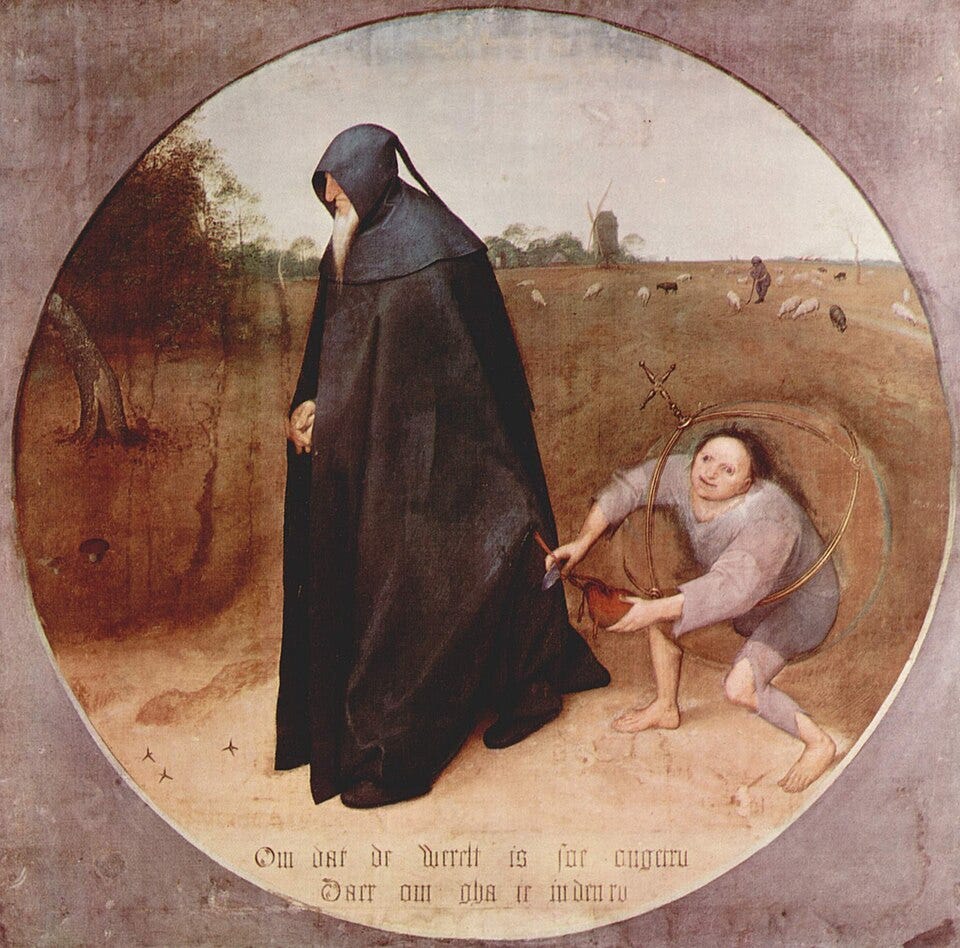
The Misanthrope (1568), Pieter Bruegel the Elder
Auto_Anon started in 2019. We had some really good years. The older half of Gen-Z were online and literate in a way I had never witnessed before. Certainly, no generation I had ever interacted with (not the “greatest generation”, boomers, gen x, or millennials) read nearly as much dense leftist theory so young of their own free will. Teenagers and early twenty-somethings messaged me daily and lit up my comment section with their interpretations of Marx, Lenin, Kropotkin, Gramsci, Lacan, Deleuze and Guattari. At the time I was grumpy that they weren’t reading Etienne Balibar, Alain Badiou, Charles Mills, McKenzie Wark, Susan Stryker or Stuart Hall. But the point is, there was an incredible energy in the air that I do not believe I will ever see again. Protests swept the nation and then swept it again. Protests were international, bleeding into each other. AI had not yet destroyed their brains. Cyncicism had not yet destroyed their spirit. Today I feel confident in saying that Gen Z is one of the most materialist, individualist, anti-intellectual, and cruel generations since we started naming generations in the 1800s. But that is not their fault. Much like Gen X, Gen Z checked out when all their very big and very active attempts at changing the world for the better came brutally to naught. Today, it is hard to get people to read the theory quotes I continue to post on Auto_Anon’s insta page. There is no longer a cultural cache among Gen Z in knowing what bell hooks had to say. Black lives, it turned out, did not matter. Indigenous calls for justice went unmet. The genocide in Gaza went unstopped. The bulldozers continued to push the bodies into mass graves. The disabled are still mandated into poverty. #metoo got a few individual men held accountable, but by and large did nothing to change a culture that reduces women to rapeable objects. Instead, the manosphere appeared to double down on just how property-coded and rapeable we women are. The president of the United States of America has said that he does not mind when people call him a fascist, and it is almost certain that he is a pedophile and a rapist. To distract from this, he has started a war in the Middle East that threatens the lives of hundreds of millions of people and will no doubt be used to further aid Israel’s genocidal intent. As this war takes its rightful place in the horror spotlight, America’s own increasingly genocidal treatment of trans people will be noticed less and less.
I have been fascinated by Stefan Zweig for all of my adult life. He was one of the most read authors of the early 20th century, having outsold many of what we now consider the greats of his time. Few remember him. Austrians still read him because he was their last great novelist. They tried to kill him, and perhaps for that crime have not had a great novelist since. Wes Anderson dedicated The Grand Budapest Hotel (2014) to him, and this briefly reminded some people of him. But mostly, he is forgotten. A Jew who adored the café culture and high society which had only recently let people like him in, Zweig’s work is awash in nostalgia for a glamourous and beautiful world that at best barely tolerated his kind. He escaped the Holocaust in great part due to his unabashed sense of nostalgia. He was convinced the Europe he loved was over, and so he fled. He was right to do so. First in 1934 (only a year after Hitler rose to power) Zweig and his wife fled to England. In 1940, with the allies apparently losing the war and a Nazi invasion of Britain seeming imminent, the couple left for Brazil. He loved it there. He wrote a book, Brazil, Land of the Future. In his suicide note he thanked the country “I am impelled to fulfill a last obligation: to give heartfelt thanks to this wonderful land of Brazil which afforded me and my work such kind and hospitable repose.” Yes, in 1942 Stefan and Elisabet Zweig were found dead of a barbiturate overdose. The drug choked them to death. His suicide note explains, “after one’s sixtieth year unusual powers are needed in order to make another wholly new beginning. Those that I possess have been exhausted by long years of homeless wandering. […] I salute all my friends! May it be granted them to see the dawn after the long night! I, all too impatient, go on before.”
Moral exhaustion is real. That’s my diagnosis for Zweig. He writes in his suicide note of his needs for a new home, “the world of my own language having disappeared for me and my spiritual home, Europe, having destroyed itself.” I think about how it must have felt to be a world away from a geographic place that once housed the social world that he loved, that fascism and the Shoah had destroyed—was in the middle of continuously destroying anew. Did he feel like an artifact of the past? What was he to believe now that what he had loved had morphed into something which hated him, which wanted him dead, which longed to kill precisely him? There was no point any longer in ringing the alarm bells. They were already ringing. There was a microphone next to the bells that broadcast their sound through speakers far and wide. He could not save anyone. His social project, his lifestyle, was dead. Hannah Arendt holds him in contempt. She derides him as a member of the bourgeois “who had never concerned himself with the affairs of his own people,”[i] meaning the Jewish people. She writes that when “finally the whole structure of his life broke down, and he experienced disgrace, he was unable to discover what honor can mean to men,” for “From the ‘disgrace’ of being a Jew there is but one escape—to fight for the honour of the Jewish people as a whole.”[ii] Decades later when Gershom Scholem attacked Arendt as lacking a love for the Jewish people on account of her antizionism, she replied: “I have always regarded my Jewishness as one of the indisputable actual data of my life, and I have never had the wish to change or disclaim facts of this kind. […] I have never in my life ‘loved’ any people or collective—neither the German people, nor the French, nor the American, nor the working class or anything of that sort. I indeed love ‘only’ my friends and the only kind of love I know of and believe in is the love of persons.” I wonder about the compatibility of these statements. Did the younger Arendt love the Jewish people, and the older Arendt lose this love? Or, is there a difference between fighting for the honour of a people you are part of and loving that people?
I have never loved the Jewish people, although I would sooner die than deny my Jewishness. I have also never been able to think about my transness without processing it through my Jewishness. Indeed, I recently gave a guest lecture at Barnard College on my book Reverse Tomboy and to my surprise a student noticed that I had included some allusions to Merkabah literature in it. Whether it be Sander Gilman’s work on the medical feminization of the Jewish mind and body, the myth of Jewish male menstruation,[iii] the broad cultural stereotype of Jewish men as weaker, hysterical and bookish, or various Jewish political thinkers’ attempts to imagine an emancipatory path forward for the Jewish people, free from prejudice yet still living amongst the goyim as equals, Jewishness is inseparable from how I approach my transness. Hell, if you catch me with the stick as far up my ass as it goes, I might even jokingly, aching with aspiration, call myself the trans Fran Lebowitz. So, I suppose I have to ask the question, do I love the trans people? My answer, like Arendt’s, is no.
I am far from the first trans author to note that the trans people kind of suck. In Torrey Peters’ novella Infect Your Friends and Loved Ones when the concept of T4T is explained to the protagonist as prioritizing trans women over all others, as an intense solidarity she replies that it seems utopic. Zoey, the woman who has introduced the concept to her, responds “Please. You’ve met a trans woman before, right? Do you think the words trans women and utopia ever go together in the same sentence? Even when we’re not starved for hormones, we’re still bitches. Crabs in a barrel. Fucking utopia, my ass” before adding comfortingly “We aim high, trying to love each other and then we take what we can get. We settle for looking out for each other. And even if we don’t all love each other, we mostly all respect each other”. I will not bore you will my petty gripes. You do not need to hear about how resentful I am that dumber women or women who put less effort in get more fame, get deals that secure their livelihood. You don’t need to hear about how afraid I am of ending up homeless while I inwardly sneer at trans women who were born to wealthy families, who got book deals just like that, who were introduced to the ‘right’ people, who had parents who could mentor them, who don’t approach each piece of writing like it could save or sink them. Our community has enough of that: crabs in a bucket. It does not do me any good to point out that the crabs nearest the top inherited a ladder. You do not need to hear me cry ‘save me’ to them. I think if you did it would just sound too much like Arendt’s indictment of Zweig. He escaped the Holocaust to Brazilian luxury and still killed himself. Arendt lived first in a camp, and then as a refugee.
If I am being honest, I feel more like Zweig anyways. I don’t have his material security, but I feel that I can only sit back and watch. Since November 8th, 2024, I have been encouraging transgender people to use whatever means necessary to leave the United States. I did not presume that leaving would be easy or even accessible to everyone. I presumed a lot of people would have to leave illegally or in poverty. However, it has been my consistent belief that the Trump regime held genocidal intent towards transgender people and that we should attempt to save as many trans lives as possible. Nothing has happened to dissuade me of this belief. Instead, a lot has happened to reinforce it. Listing all the horrors I worry would merely come off as gloating, and I am in no mood to gloat. So, if you’ve somehow no clue what I am talking about, go read Erin’s work. If you are in the USA today and you are transgender, I think you should leave as soon as possible. You do not have to listen to me. I suspect you will not. But I have not changed that belief. And I feel a little insane still holding it, not because things have gotten less genocidal, but because I’ve witnessed it not hold. Instead, I’ve seen numerous trans friends and colleagues return to America. It is as if they think there’s something good about being a victim. It is like they think it will purify their souls.
It will not. At the behest of my token capital L liberal friend,[iv] I have been reading Judith Shklar. While some of the logical jumps she makes to justify capitalism and oppose revolution are truly mind-boggling, I must admit her prose is beautiful and at times deeply insightful. Her liberalism is one of pessimism, and she openly aligns herself with long-dead gay French writer Montaigne in who she identifies a “conservativism of universal disgust”. An atheist who viewed the desires of the body as truer than the artifice of human society, Montaigne justified his conservative political stances out of a fear that what humans might replace the French monarchy with would be worse than the monarchy he despised.[v] According to Shklar’s reading of him, Montaigne simply could not get over “the feebleness and pettiness of the reasons offered for public enormities” sufficiently to produce a doctrine of progressive improvement or radical change. Montaigne would struggle his entire life with misanthropy, valorizing the behaviours of animals and peasants to try and assuage it, but ultimately only finding true solace in his “friendship” with La Boétie. Of this Shklar is relieved, for “Surely, loathing one’s kind and oneself is hardly the best cure for cruelty.”
On this, I agree with Shklar. Because of this I am faced with the question that haunted so many Jewish writers during and immediately after the Shoah, “Why didn’t more save themselves?” Once you’re in a camp it is too late. I think we can all more or less agree on that. Once you’re locked inside a ghetto it is probably too late. Once it is illegal to leave the country, once they’ve taken your passport, it is not too late, but it is much, much harder. So, the trick for surviving an organized genocide is about knowing how long you can stay before you are forced to stay. Arendt fled to France but then was sent to a camp in France. Zweig fled to England and then suspecting England was not safe, to Brazil. Others, men like Viktor Frankl, did not flee but survived via luck and via cruelty, and then documented it. They did not think it ennobled them. Frankl said it reduced him to the morality of a starving animal.
I do not hate my fellow trans people. I do not hate my trans siblings in America. I want them to leave. It brings me to tears knowing that I am here safe in Canada and that they are in America and are not safe, may not be able to leave. I feel myself pulled in by the soft comfort of misanthropy. I want to scream at them. I want to scream at them because I feel powerless to help. I want to scream at the ones who were safe and went back the most. I need to scream. I do not scream. I hate everyone else. I hate all Americans who are not trans. I do not actually hate all Americans who are not trans. I just feel abandoned. And I feel useless. I feel unable to help. I feel increasingly unable to help. I think about my friends who went back. Some of them did it because they convinced themselves it wasn’t actually so bad. Others couldn’t live with the pre-emptive survivor’s guilt. Many went back “to fight”.
It is pretty passe at this point to talk about our culture of victimhood. Writer after writer has noted how the alt-right and the left alike cannot stop claiming victimhood as a moral high ground, how politicians, rich boys, and leaders scream that they are the silenced victim when they are merely being held accountable. No one is better than victims in our culture. Shklar noted this. She noted it in us, and she noted it in Montaigne. You see, he hated cruelty. It was to him the worst vice, and he hated what he deemed vices. Victimhood was a way of ensuring moral purity for Montaigne. He believed that “Only victims can rise to true fortitude, because Fortune has obviously deserted them. The glamour of glory is quite gone. What matters is how bravely one endures defeat.” For Montaigne victimhood is a way to be good. Shklar is rightfully disturbed by this. She reminds us that victims too “are pawns of Fortune, no better than her favourites. They are just losers. To favour them extravagantly is, however, a way of escaping from misanthropy and of finding an ethos that, unlike revealed religion, leads neither to zeal nor to cruelty”. To believe that victimhood makes one good or noble is merely to dehumanize the victim by rendering them more than human in our discourse. To render a human more than human in speech is nothing except a lie. That’s all it is. It is a lie. Skhlar insists “even at the cost of misanthropy, one cannot afford to pretend that victimhood improves anyone in any way. If we do not remember that anyone can be a victim, and if we allow hatred for torture, or pity for pain, to blind us, we will unwittingly aid the torturers of tomorrow”.
Shklar is not writing from the perspective of a victim, or a future victim though. She is writing from comfort and to people equally as comfortable. She is asking what victimhood and cruelty can tell us politically, what ways of thinking about them we should avoid. I am writing to you as a future victim. I am pretty sure I am safe (at least currently). I am not at all sure that you are. Shklar writes that “Every question about responsibility, history, personal independence, and public freedom and every mental disposition haunts us when we begin to think about victims. That has become especially so thank to the great massacres of our age. We too have been driven to adopt some of the expedients to which Montaigne […] resorted, to protect ourselves against utter despondency.” As I said, Shklar is writing as a witness, and thus, inherently, as survivor, not a victim. I am telling you, do not protect yourself against utter despondency by choosing to become a victim. If you are outside of the United States, stay there. If you are inside the United States, leave if you can. There is nothing good about being a victim. It does not say anything good about you. It does not purify your soul. Leave. I do not want to die alone in Brazil.
[i] Which is unfair. Zweig wrote several stories about pogroms and other forms of Jewish plight and persecution.
[ii] You can find her whole article about him in her collected Jewish Writings.
[iii] The myth of Jewish male menses - ScienceDirect
[iv] I specify capital L liberal because to my dismay most of you leftists reading this are liberals in the literal political philosophy sense of the word.
[v] Fun fact, his lover Étienne de La Boétie was a proto-anarchist and wrote a wonderful piece on voluntary servitude