The Yearning Years
Or: A messy analysis of lesbian yearning

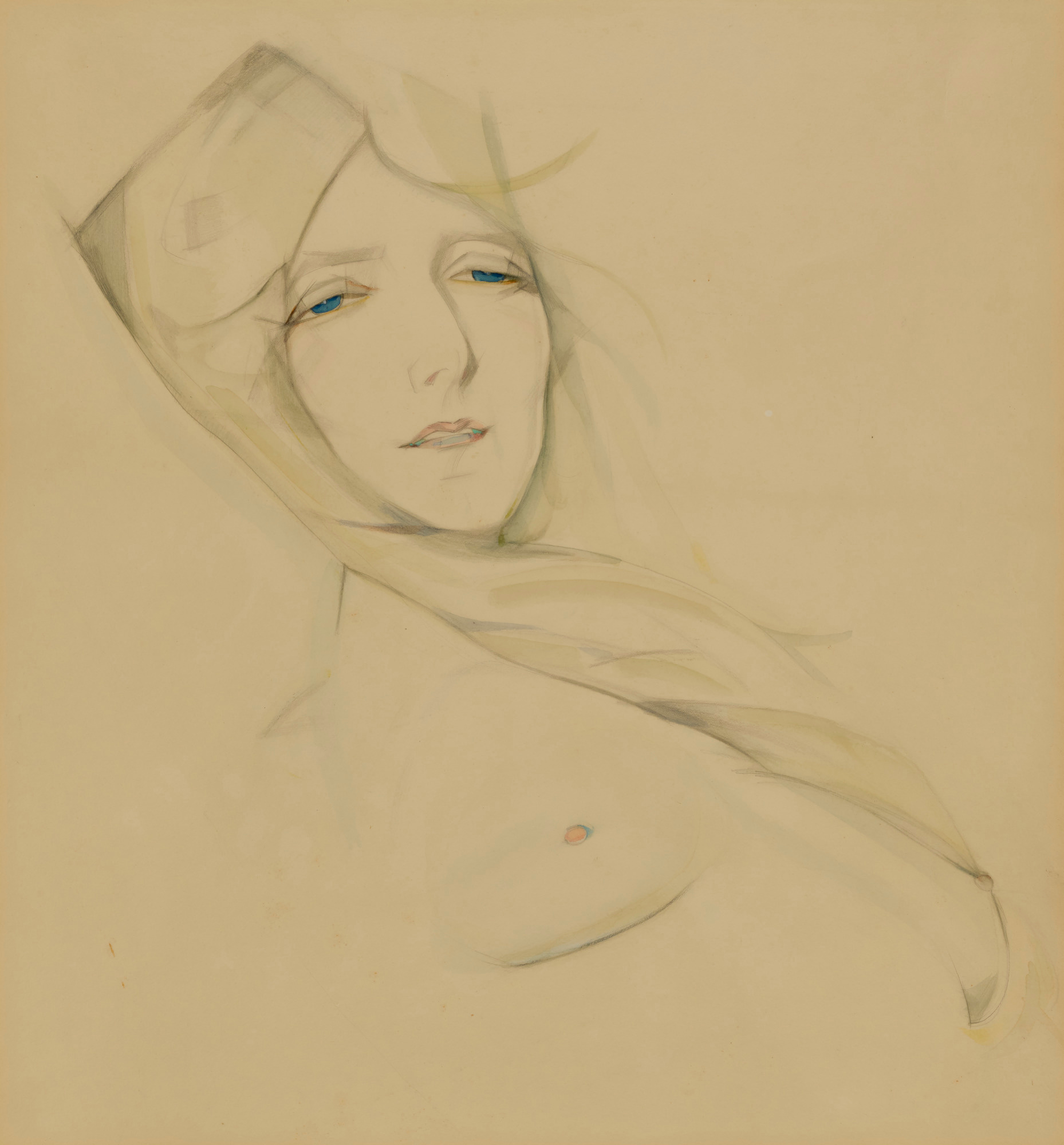
Eyre de Lanux, Natalie Clifford Barney, ca. 1921, pencil and watercolor on paper, Smithsonian American Art Museum.
One of the biggest hits of the winter 2026 anime season was a show entitled “Shiboyugi: Playing Death Games To Put Food On The Table”. It was beautifully stylized, intriguing, and felt like it had something to say about cruelty, modern womanhood and the contemporary Japanese economy. In it, we find the protagonist Yuki playing death games, which are exactly what they sound like (think Squid Game) for an unseen audience (us?). Yuki is a detached girl who through the course of the show must reckon with the fact that nothing is pushing her to play death games, that she does not understand why she continues to sign up for them. She is not in the type of debt the other girls tend to be. So why does she play? For this essay’s purposes it does not matter why. What matters for us is that she is interested in why others do. In episode six, aptly titled “Who’s ---ing You”, one such other is a tomboyish girl named Azuma. During a particularly brutal death game taking place in an abandoned spa, Yuki and Azuma (who have teamed up) have a moment of downtime, lounging by a large pool. Azuma asks, “They’re all good girls, aren’t they?”. The question lingers, why would normal, pretty girls do this? Yuki gives an affirmative grunt, as if to say “yeah”. That grunt is enough for Azuma to follow up her question with what she is really talking about, “Why are you in this business?”. Yuki, a slender long-haired femme continues to stare blankly forward. Azuma allows an anxious look to cross her face, but restrains herself from looking to see if Yuki is looking at her. Yuki gives her standard, somewhat canned response “To beat 99 games, that’s my goal”. On its surface it is already painfully arbitrary. We later learn, it’s not even her original goal, but one she adopted from a former player. Perhaps it’s covering up what Azuma hopes is a shared reason. The animated-camera moves from Azuma who is finally turning to look at Yuki, to a close up of Yuki’s heavily mascaraed eye. Then Yuki returns the question “What about you?”
Azuma now has to confess. The question has been turned over to her despite being so unfairly answered by Yuki. She replies “Huh? I, uh…For normal reasons.” Yuki decides to prod. “Normal?” she asks, no doubt expecting a discussion of debt or a sick relative. Azuma apologizes, “Sorry. I guess it’s not normal.” Then the real insecurities come out. Azuma begins, “You think a girl as masculine as me does well in the real world?”. The two are shot from the back, the wide expanse of the pool room framing their bodies, which sit, close enough, but nervously apart. Yuki replies “I don’t think there’s anything wrong with you,” before relaxing her grasp on her knife, and adding “It’s better than people who refer to themselves in the third person.” What the it is that is better is unstated but understood. Azuma gasps, and turning towards Yuki again, we see her eyes widen. She laughs, “Yeah, you’re right. I wonder why. It’s not like I can’t wear my uniform, act amicably, and talk more like a girl. It shouldn’t cause me any pain. But once I started thinking about it, I struggled to talk to friends, go to school, leave the house, eat with my family, or do anything at all. Slitting someone’s throat and killing them is easier.”[i] Watching the scene, it is difficult not to see it as a lesbian one: two girls attempting to understand each other, to determine how safe the other is. Azuma yearns for another that is like her, that might be doing this for the same reasons as her, for those reasons to be ‘normal’ to her. The show, and especially that scene, is one of navigating the tension between closeness and safety and the gap between them which we call yearning.
I want to talk about the central role yearning plays in lesbian media and lesbian life. In an interview, Lori Miyazawa, author of the popular yuri (also known as Girls Love) series Otherside Picnic, was asked about the definition of yuri. They suggest that “a concept of ‘yuri of absence’ is beginning to form.” Later in the interview Lori adds:
“There is this movie called “Sicario” by Denis Villeneuve, released in 2015. It’s a thrilling masterpiece about the drug war in Mexico. The composer of the movie soundtrack, Jóhann Jóhannsson, passed away this year, and according to one of his interviews, there were two themes in the soundtrack. The sense of dread of two wild beasts glaring and pouncing at each other represents the battle to the death between the illegal police force and the mafia. And the other theme was the melancholy of the border area, two emotional themes. If you listen to the soundtrack with that in mind, you cannot perceive it as anything but “yuri”. Though the movie itself is not yuri at all… Two wild beasts glaring and pouncing at each other. It’s yuri, isn’t it?... And the sentimentality of the border area is also yuri”.[ii]
Is that what it is to be a lesbian? My lesbian reader, is this how you find yourself? Do you find yourself in a beautifully sparse and hostile space? Are you aware of that animalistic sex drive inside you? Does it scare you? Do you find yourself staring at other women, wondering if they’re like you, wondering if they’d love you or instead love to hurt you?
Do we ever shake off our formative sexual experiences? Will some part of us always be that young girl who horrified by the sudden violent revelation of the unwanted attention of creepy, older, leering men, and gross, boorish, loudly horny boys, is struck by a second troubling revelation: that she has caught herself looking at girls with the same wanton need as those men who look at her? On one hand yearning appears as a state lesbians find themselves in because we are afraid of acting on our desires. Perhaps, having grown up on the idea of the predatory lesbian and classmates who ostracized anyone wearing flannel we are afraid that our desires made manifest will be at best unwanted, and at worst considered as some type of nebulous harm. “Cindy is my friend; I can’t risk losing that.” We yearn because we dare not act. There is too much to lose. What if she doesn’t feel the same way? How do I make my desires known without making either of us feel gross or embarrassed? Raised to assume the passive role in courting, we lesbians often feel utterly inept at navigating the active, at asking, at going for it, at leaning in for the kiss. Yet, on the other hand, yearning is something we yearn for.
Currently, I’m in three very happy long-term relationships. There’s very little conflict, and pretty much everyone is getting their needs met. I have very few complaints and so do my partners. Marriage is often discussed, although not yet acted upon. We have dinners and movie nights together as a family. When one of us is down on their luck, the others step in to help out. We no longer know whose books are whose. It’s blissful. However, I spent a substantial amount of my free time consuming yuri. I started consuming these rather outrageous amounts of yuri after a few very unsatisfying years of being a slut. I thought that what I yearned for was exciting sexual novelty—a new girl every now and again to spice things up. Except, the hookups I was having via dyke bars and lesbian dating apps were never quite giving me what I wanted. Yes, the sex was nice, and yes, I made friends with a variety of interesting women, but it wasn’t quite right. My psyche needed something these late-night encounters were not providing. What I needed, it turns out, was yearning.
A trans woman friend of mine who is relatively early in medical transition was telling me how she was having difficulty navigating the change from having the sort of spontaneously activated libido that is associated with a testosterone dominant endocrine system to the “responsive desire” style of libido associated with an estrogen dominant endocrine system. A lightbulb went off in my head “damn, is that why I keep dating girls with PCOS?” A truly surprising amount of the cisgender women I’ve been with over the years have had PCOS, which among other things raises one’s testosterone levels.[iii] In those relationships I would initially be overjoyed by the other girl’s speed and directness in pursuing me. They swept me off my feet again and again, and each time made me feel incredibly desirable. Then, after a few months to a year, it would break apart. I’d realize how ready they were for sex at the drop of a hat, how they did not seem to need to warm themselves or me up, how it felt increasingly perfunctory, de-eroticized. We’d be laying in bed and suddenly their hand would be in my panties. I’d rush to try and get turned on, and usually fail. There was no wooing or getting me in the mood. There was no psychology at all. Then we would break up. It simply lacked the yearning. Not that I knew that yet.
I learned that I needed yearning by consuming lesbian media. For a long time, it was unclear to me what made up my taste in movies. There was a stillness that ran through my favourite films, and a mood that I could not name. But looking at a short list of my favourites, I couldn’t figure out what united them: In The Mood For Love, Portrait of a Lady on Fire, Lost In Translation, The Reader, Let The Right One In, Moonlight, Taste of Cherry, Ocean Waves, The Bitter Tears of Petra von Kant, Mullholland Drive…some of them cruel and upsetting, others were beautiful and full of peace; I could not name the connecting thread in these works, not until I started reading yuri and consuming lesbian media made for lesbians. Then I realized, like many other lesbians, what I yearn for is yearning. I couldn’t tell you precisely what work snapped this realization into focus for me. Maybe it was NANA or Bloom Into You. Perhaps it was Whisper Me A Love Song or Even Though We’re Adults. I know at some point I started to realize that I got more of the emotion I was looking for by staying home and playing the lesbian video game Hardcoded than I did by having yet another dyke bar bathroom quickie. I don’t love sex; I love intimacy, and perhaps above all, I love yearning. It turns out that you don’t need the most emotionally sensitive partner. You just need to speed read two volumes of Pink Candy Kiss until you eventually get so overwhelmed that you straddle your girlfriend and beg to shove your tongue down her throat.
I think it is worth asking why we yearn. Certainly, yearning is part of women’s sexuality more broadly. Harlequin Romances were a previous straight generation’s yearning central. Arguably by the 1980s with its Romancing the Stone levels of straight yearning, the straight woman had surprised the dyke in yearning power. There was a yearning gap. Lesbians, the competitive bunch that we are, could not let this stand, and quickly took back our yearning birth right. Now straight women are digging all day in the heteropessimism mines or trying to lobotomize themselves with whatever the hell it is Hannah Neeleman sells, until they’re perfectly happy in the sort of marriage their great grandmothers fled from. I hate to tell you but Edna didn’t ensure Frank ‘fell down the stairs’ so that her descendant could be married to Frank 2.0, now with a podcast addiction. Meanwhile lesbians, who once were very good at being both yearning and slutty, have mostly become yearning machines. Lesbian bars have, to my knowledge, never been quite as plentiful as gay bars. Yet one need only watch movies like The Joy of Life or Mango Kiss (or browse the archives) to realize that lesbian life was a lot more openly horny in the 20th century than it is in the 21st. Even the bisexual girl on House is sluttier than most of the dykes I currently know (myself included).
Part of me wonders if it is not a coincidence that lesbian media and depictions becoming more mainstream coincided with a downturn in lesbian sexual activity and an upturn in yearning. Since I am of a certain age, Buffy the Vampire Slayer gave me my first positive media depiction of lesbianism. Willow and Tara’s relationship will always have a special place in my heart. Yet the writers seemed insistent on giving them tension after tension to work through. Other characters on the show got to happily date someone without it being a big deal. Even Willow’s previous relationship (with a man named Oz[iv]) happily faded into the background upon becoming established. Xander and Anya also had lengthy periods of established bliss. Willow and Tara however were constantly torn apart due to internal or external strife, and thus, constantly yearning. Things have hardly improved. Gen Z’s version of Willow and Tara, Euphoria’s Hunter Schafer and Zendaya, are never permitted to become a fully formed stable couple. They are locked into a series of desperate attempts to break through to each other and make the changes to achieve the stability they’re never granted. In yuri things are little better than in the west. At least you’re a lot less likely to see a member of the couple die or the couple breakup, but most yuri stories end once the couple have formed into an official couple. I’m actually reading a yuri right now called How Do We Relationship that, if the author’s notes are to be believed, was born out of a desire to discuss the actual ins and outs of lesbian dating, since pretty much every other yuri out there focuses just on the initial getting together of it all. Is it possible that one of the reasons that we lesbians define ourselves by our immense capacity for yearning is because as lesbian depictions have become more mainstream there’s been an increased desire to desexualize them, to focus on the purity and sweetness of the emotions wrapped up in them, instead of the joys of boinking each other. Has lesbian visibility convinced us that we don’t want sex, we just want to yearn?
The modern lesbian has available at her slender fingertips nearly ever type of yearning imaginable. You want tragic yet mundane yearning: My Broken Mariko. You want formative midwestern yearning: But I’m A Cheerleader. You want campy yearning: D.E.B.S.. You want abuse of yearning: The Favorite. You want evil sci-fi villain yearning: The Traitor Baru Cormorant. You want body horror yearning: Black Flame. You want horny yearning: Asumi-chan is Interested in Lesbian Brothels! You want horny yearning but make it pathetic and unjackoffable: My Lesbian Experience With Loneliness. I could go on and on. There’s a piece of media to hit every yearning niche. But what does it say that myself and many others are turning to these fictionalized works not only as a substitute for real sapphic intimacy but as definitional of our dykehood? Why are so many of the lesbians I know[v] obsessed with fictional characters? In our media saturated moment, it is not surprising that so many of us understand reality through its artistic stylizations on screen or in text. In one of the early narrated monologues of The Dreamers the protagonist tells us of his time as a cinephile in Paris, where he saw “images…so powerful, it was like being hypnotized.” The hyperrealness of the cinema leads the protagonist into a sort of addicted state, where he ceases to prioritize his own life, and begins to view the fictions on screen as the realest real, as truth: “I was one of the insatiables...the ones you’d always find sitting closest to the screen. Why do we sit so close? Maybe it was because we wanted to receive the images first when they were still new, still fresh, before they cleared the hurdles of the rows behind us, before they’d been relayed back from row to row, spectator to spectator, until worn-out, second-hand, the size of a postage stamp, it returned to the projectionist’s cabin. Maybe, too, the screen really was a screen. It screened us from the world. But there was one evening in the spring of 1968 when the world finally burst through the screen.”[vi] Is this what we lesbians have become? And if so, what will it take for the world to finally burst through for us?
It seems to me that increasingly we live exceptionally depressingly normative lives, lives that mimic heterosexuality. Gone are the days of the lesbian avengers. The lesbian sex mafia is still out there thank fuck, but it has been too long since they’ve had the importance they once demanded from all of us. Are we really okay having a monogamous girlfriend, a golden retriever, a cute little apartment that we’ve fixed up in pastels or tasteful creams, while we leave our fantasies as mere fantasies—our sexual desires unexplored? Then of course, there is the second part of our group, who you can find at events named things like GrindHer, Hysteric Wrestling, DykeBite, Amazon Swap, and Strap Envy. Most of these events are organized by trans women, which considering that they make up such a small amount of our population, tells us something about how ashamed the cis lesbians are these days of having these desires. And in these spaces you will, of course, find some wonderful lesbian sex to be had, but most of the girls I know who go to them find themselves pleasantly exhausted, but psychologically unsatisfied. The sex is exciting, varied, kinky, and plentiful, but anonymous and ultimately fails to deliver that sense of mutual desire that yearning for one another provides in plenty.
I think when we talk about our love of yearning what we’re actually talking about is a desire to be actively pursued. We want to feel worth picking out from a crowd, worth investing time in, worth day dreaming about, worth blushing about; to put it succulently, we want to feel worthy of singular romantic interest. And we want to feel this interest from someone who we have allowed ourselves a similar level of emotional attachment to. Yet so few of us are willing to actually offer that up to the other. It’s cringe (aka scary) to be so honest. I can’t tell you how many lesbians I meet who insist on calling themselves Avoidants, referencing the avoidant attachment style (a psychological system intended to describe children[vii]), as some sort of badge of honour—a blank cheque to treat others with callous indifference, rather than a dubious attribution at best, and a severe issue to work on repairing at worst. And yet so many of these same people will wax poetic about their love of yearning! What is going on?
Is it possible that we have replaced romance with yearning? Have we decided that to be a lesbian is to be miserable, always wanting what is just out of grasp—sexualizing the distance between our hand and that which we desire to touch? It seems to me that we have taken our responsive style libidos and mistaken that initial activation of these libidos (via yearning, via wanting) for the actual fulfillment of our libidinal desires. Somehow, we’ve convinced ourselves that wanting is the same as doing, is better than doing, is more pure than doing. Turning on the machine at the factory has been confused with receiving the finished product. Planting the seed in the earth and witnessing it sprout has been confused with smelling a beautiful lily that you’ve grown yourself. Yes, the initial spark of romance is beautiful, and yes it is something that in our world of apps, hookups, and instant messaging, has grown more rare, but it is not the goal. It is not happiness. It is not sustainable. And it cannot be a substitute for a full-blown fling.
It seems to me that by valorizing yearning above actually getting together we have actually reproduced and heightened the communication crisis that already existed among lesbians. The joy of yearning and the centrality of yearning has allowed us to justify inaction. It has allowed us to justify love at a distance. It has permitted us to never actually make ourselves vulnerable in the pursuit of lesbian happiness. With yearning we need not do anything but stare sheepishly and imagine how beautiful our bashful eyes must look darting away as our crush glances back. Yearning allows us to imagine the perfect romance with a person, without ever having to be confronted by the reality of dating them, of getting to know them, of finding out that they are just a girl, with little beautiful imperfections, that scare you, but which you could love, if only you did not run away to stare across the still wide waters of some beautiful pond at the next girl who remains outside your grasp.
So let me suggest something else. Maybe all those fears you have, about what people would think, about what she might think, about your age gap or who her friends are and what beef they have with yours, about her fashion, about her movie taste, about some half substantiated rumour you heard somewhere, about how you don’t ‘know if you’re emotionally ready’, if you’re ‘emotionally recovered’, if you’ve spent enough time ‘learning to be single’, or if she’d be mad if you talked to her, or that you don’t know what to say, or maybe she remembers that one time you accidently upset her or one of her friends…maybe all of that is just the screen, that is keeping you inside, that is preventing you from going after what you really want. Maybe you can continue to yearn for her when she’s off at work, or vising a friend. Maybe you can be excited to come home to her. Maybe she’ll go away on a business trip and you’ll write letters telling her how much you miss her. Maybe she’ll come home and caress you and whisper into your ear. Maybe you can be happy with someone. Maybe you can still yearn for someone you’re with.
[i] There’s a trans reading of this, of course, but I want to focus on the lesbian one. Lesbianism and trans masculinity have always slipped in and out of each other. In Jenni Olson’s The Joy of Life (a must watch film), the narrator recounts how a fellow dyke commented on her breasts, about how according to her butches have the best breasts, but also hate them. Trans masculine people slip in and out of the sapphic community with more ease than trans women do in the gay male community or for that matter the sapphic community. It can be difficult to untangle butch expression from trans masculine feeling. But my concerns today are not with trans masculinity but rather with lesbian sexuality. I do not mean this to invalidate trans masculine readings of Azuma. My reading is far from authoritative.
[ii] https://teletype.in/@kati_lilian/SJA8KwjjN
[iii] I want to clarify here that I don’t believe that this is some sort of universalizable biological personality typed tied to having PCOS. It’s merely what I’ve personally experienced and my brain’s own strange way of attempting to make sense of it.
[iv] you could say he was a friend of Dorthy…
[v] And frankly especially the cisgender ones.
[vi] http://www.script-o-rama.com/movie_scripts/d/dreamers-script-transcript-eva-green.html
[vii] What People Get Wrong About Attachment Theory | Psychology Today