

“Spectatoring”, Dissociation and Camp Miasma

This is an article about Teenage Sex and Death at Camp Miasma (2026) dir. Jane Schoenbrun. I saw it at the Canadian premiere, and am reporting back. If you have not seen it yet (which is probable since it isn’t out yet) please be aware that there are some spoilers in the article. I have tried to avoid anything too plot heavy, and left things vague as much as possible. Direct quotes are primarily from the trailer. However, if you are of the wrongheaded mentality that knowing anything about what happens in a narrative ruins the narrative, you may wish to sit this article out.
I survive on the income I make from Substack. Once a month I write an article about media I enjoy. These are paid articles that are intended as thank you and as a reward to my paying subscribers. The idea is that it allows me to give them something special extra, without paywalling any of my more ‘hard hitting’ or pertinent articles. The paid ones are often a little more raw, and on a lot less serious topics. They bounce around and allow themselves to have fun with it. This is one such article. Enjoy.
Do you sufficiently know your body? Do you know your own body enough? Should you know it more? Should you know it better? Are you sufficiently in it? Do you feel embodied? Can you feel everywhere? Can you relax your forehead muscles? Do it for me now. How many hours a day do you spend fully at home with yourself? A real woman doesn’t rely on distractions. Womanhood is about knowing your cycle intuitively, without an app. A real woman is never surprised by her period. Trans women get periods too, and the ones that are good real true women know when they’re bleeding even though there will never be blood. Women just know. You’ve let all this bullshit distract you. What are you doing masturbating like that? A woman truly in touch with her own femininity wouldn’t need that. A good woman, one who knew herself, wouldn’t need a vibrator. She wouldn’t need pornography. Hell, a really embodied woman doesn’t even need to fantasize. She must lie there and commune with her vulva. Afterall, if you picture a man, aren’t you fantasizing about patriarchy? Worse, picturing a woman is projecting a narcissism of minor difference, a male fantasy fed through a female brain. You must lie there and commune with your body. Express the intimacy you’ve learned to have with yourself. It does not matter if you don’t cum. Orgasm is a male goal. The joy of a woman’s body needs no other than itself. So, let me ask again, do you know your body sufficiently? Are you one with it? Do you never hide? You must unlearn patriarchy and the male gaze. You must practice wellness.
Since at least the 1970 publication of Masters and Johnson, women have been asked to consider how present they are during sex. Today we call it dissociation. Masters and Johnson called it “spectatoring”. They described it as this negative tendency to imagine oneself outside one’s own body, watching the sex happen as if from a distance. By 1977 men were already using it against women. In Anne Hall the titular character goes to smoke a joint before sex, leading her boyfriend Alvy to complain “I don’t know why you have to get high every time we make love.” She explains that it relaxes her, and his bloated ego takes a hit. It has to be about him: “you have to be artificially relaxed before we can go to bed?”. She insists that it makes no difference, but he shuts her down with a cruel joke “Well, I’ll give you a shot of sodium pentothal. You can sleep through it”. He talks her into going without the weed, and the movie confirms his suspicions. He immediately notices that “It’s like you’re- you’re removed” and “distant”. An overlay representing her inner self, ghostlike, moves up from the bed and sits down on a chair, watching as the couple try to fuck. Her inner self sits there and looks around for a drawing pad to occupy herself. Alvy notices and confronts Annie again. She insists that she needs the weed, and he shoots back that “it ruins it for me if you have grass”. The male ego cannot understand that it isn’t about him. Annie’s own relationship with sex, with her body, ultimately with pleasure is positioned as an issue for the man. He cannot evaluate if he’s actually ‘performed well’ if he knows that she has taken a substance to aid her enjoyment. He must prove to himself that he can bring her to orgasm without aid. Nowhere does her desire to have fun, to make things easier for herself, play into things.
By the nineteen eighties feminists were beginning to agree with Alvy, played and written by Woody Allen. The anti-porn, anti-sex feminists of the eighties were beginning to get suspicious of whether or not women were getting off in the right way. Orgasm was declared a male goal. The aid of vibrators, straps, pornography, and yes, even sometimes imagination was written off as perverted, improper, and male. It had once been that feminism was the theory and pervert-style lesbianism was the practice. Now, sex was meant to be an expression of intimacy, the way a kiss says I love you. It wasn’t supposed to be fun or pleasurable.[1] Somehow, as the decades passed, this impulse perverted itself and morphed into our new idea of Wellness. Wellness is a billion-dollar industry, and it sounds so much nicer than sex. Wellness includes massages, and yoga, thermal bath cycles at Scandinavian style spas. Wellness includes meditation, therapy and journaling. It includes diet and exercise. And yes, it also includes buying the right vibrator for you. Wellness too is part of the war against “spectatoring”. Afterall, wellness is about female empowerment, or at very least, female embodiment. There’s just so much in this busy modern world of ours that distracts you and takes you out of your body. It’s even harder for women. So much is asked of the modern woman, the modern mother. Wellness is here to help you relax. Wellness is here to help you find you in you. Let Wellness help you reconnect with yourself. Take some me-time. You deserve it. This podcast will teach you how to really feel like you’re inside your body again. Let it teach you how to learn the subtleties of your body, of you.
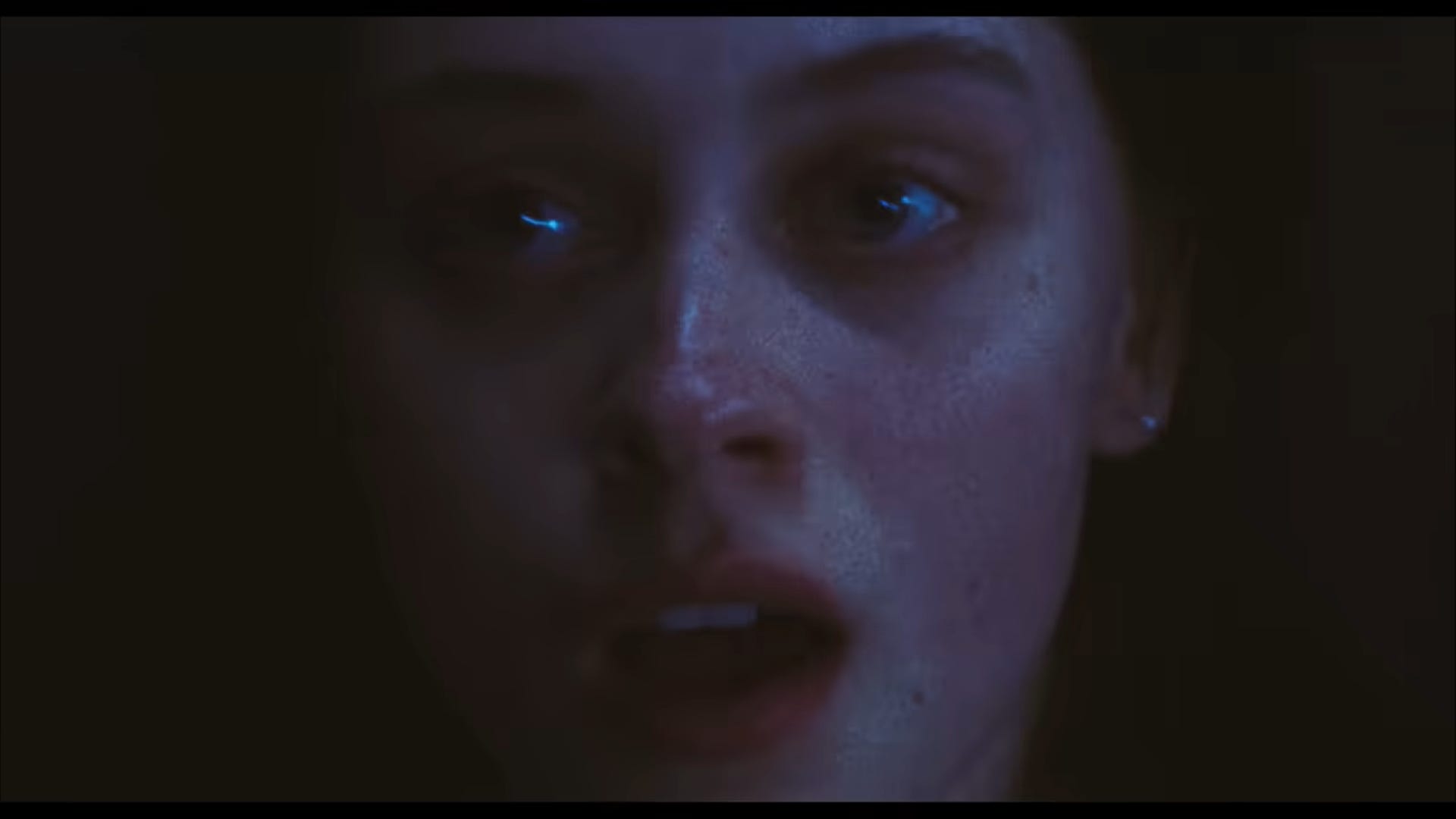
Teenage Sex and Death at Camp Miasma (2026) says no, fuck you. What was the look in Orpheus’ eyes like when he saw Eurydice still in the shadows, clawed back into the underworld? There would have been fear, and shame, and, well, maybe something else. Maybe he saw her seeing him. Maybe, for a second, in that fatale held glance she ripped something from him as she met his stare. She got to watch him the whole time. Was she afraid too? Or was she staring at the back of the man who she loved, who was leading her away to safety. Did she still have love in her eyes when he saw them? And why did he interrupt the straight path to heterosexual bliss he was walking with her, in front of her, guiding her to it. What if their eyes met in mutual relief? What if they saw what the audience sees at the end of The Graduate (1967)? What if when Orpheus diverted from his march to heterosexual marriage he turned around and saw that Eurydice was relieved? What if he saw his own relief reflected in her eyes as she disappeared back into the land of what we do in the night? When he looked at her, she looked at her through his eyes, and he looked at him through hers.
