

Sex Working Through Your PhD
How Academia Creates a Pipeline To the World's Oldest Profession

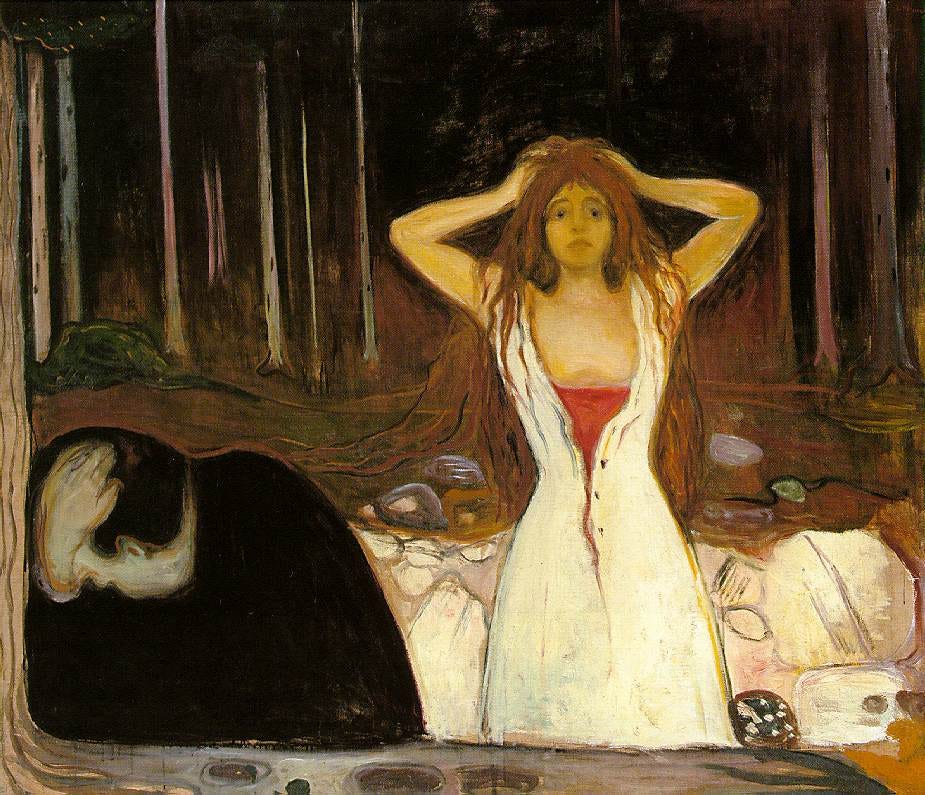
Edvard Munch, Ashes (1894)
During my first month of my PhD, I went out for a walk with a new friend of mine. They were few years ahead of me in the PhD program. I’m new to the city. I’m from a big city. I’ve lived in several big cities. Each new big city I’ve lived in has seemed larger than the last upon first moving there, even the smaller ones. It is as though knowing the geography shrinks the city. I don’t know this one yet. So, it stretches around me. We’re in a neighbourhood I would later learn to call the mile end. It’s queer, loud, and bustling. I don’t know that I’m still close to my apartment. It feels as though I’ve been walking for miles. They can sense it and offer to take a break at a café. I quickly agree. They pull me into a bustling café. It’s massive yet nearly full. Its insides spill into its outsides. The summer heat gives it the feeling of an oasis. The sun spills inwards through the massive open windows and shimmers off my friend’s long light hair that encircles their slender frame.
“I screen my clients here. It’s a good place for it: open late, protective staff,” they offer apropos of nothing. I get the sense that it is advice, for when I inevitably do full service. I nod and ask a few follow up questions. Afterall, who am I to turn down help?
A couple years later I’m drunk at a bar on Rue Mackay with a girl a year below me in the program. Despite different gender modalities, difference races and religions, we’ve bonded the past few months. We’re talking about anime, about demons, big swords, and gay love. The place is fairly empty. We’ve the back room to ourselves. Occasionally the waitress comes and delivers us another around of cocktails. I’ve gotten into cocktails. They seem more feminine. Somehow, we start talking about our insecurities. I talk about the transmisogyny dogging me throughout academia. She’s relaxed, a finger playing with her black silken hair[1]. She tells me about racialization, about subtle sneers of liberal paternalism from her professors. I talk about how I always feel monitored, the way someone monitors a potential threat: a skunk on the neighbour’s lawn, an unmuzzled big dog on the subway. I say that it makes me afraid, that they’ll find something I don’t even know about that will allow them to label me nebulously ‘bad’. Then she tells me that her big fear is that someone will find the porn she’s made. She says that when she first started making it she was dumb, she did not disguise her identity at all. She says a simple google is all it would take.
A year ago, a friend takes me to an amateur strip night. They explain that it’s not so much actually amateurs, but instead an excuse for queer strippers who usually have to perform for a straight male audience to show off their skills and have a little fun in front of the people they’re actually attracted to. It’s incredible, somewhere between burlesque and the sort of stripping I would expect. A girl in boxers and a sports bra spins on a pole with an incredibly lazy vibe, her body pretzeled into a position that would kill me, holding onto the bar with only one hand. Her other hand is slowly eating a big mac. About half way through the burger she wraps both her legs around the pole, bending backwards with core strength that would make any callisthenics girlie salivate. She places the half burger down on the placemat she has brough, picks up her McFlurry and her fries, sits back up, vertical again on the pole, and begins to eat the fries, dipping each into the soft-serve concoction before each bite. I’m in awe. Afterwards a few of the strippers rush over to my friend. The girls all know them from grad school.
Two months ago, a PhD student who goes to one of the other schools in my city hits me up for a drink. I readily agree. They’re a cool girl. We drink together often. For awhile I was supplying them with HRT. It made getting together a necessity even during the busy parts of the semester. But they’ve had their own supply for awhile now, and it is exams. Instead of the usual boozy drinks, today we’re having coffee on her couch while she ignores the marking that has piled up and the papers she has due for her own schooling. It turns out that what’s really on her mind is how to survive the summer. Grad students typically only get their funding handed to them during the year. So, you might have $15,000CAD (roughly 10,000USD) for the year to spend on groceries and rent divvied out to you in monthly installments of $1875CAD ($1,363 USD), but only between September and April. Once may hits, well, you’d better have somehow saved some of that to get you through May, June, July, and August. To survive off of $1,500CAD ($1,000USD) a month in the summer, that means saving $600 per month of your $1875. I’ve never successfully done it. Usually, I have about $1000 saved per upcoming summer month, if I’m lucky. By August I’m surviving on very little. Judging by her worried tone, she hasn’t managed to put away enough for anything but the bare necessities, if that. And who can blame her. When you survive on poverty wages, how are you supposed to save for seasonal unemployment? It takes about $40,000CAD to ‘live with dignity’ in Montreal (which has four major universities plus other well-respected colleges). The official poverty line is lower. It is $23,907CAD per year. We’ve surviving on $15,000. How? She doesn’t know either. At least she doesn’t know how we’re expected to. She knows how we do. That’s why she has called me here. She wants to know how to get started doing sex work.
The truth of the modern North American PhD is this: you cannot survive it without familiar wealth or by becoming a sex worker. I do not know of another socially reputable thing that pushes as many people into sex work as academia does. Maybe Olympic athletes (who are severely underfunded in Canada) also fall back on it in high numbers? It’s possible, but I’ve never run into one to ask. Frankly, even the socially unreputable things like drug addiction or familiar trauma appear to me to have lower rates of whore-creation. At least a drug addict is allowed to hold a job. Meanwhile, most PhD Programs[2] make it very clear either contractually or with threats of removing funding, that a PhD is expected to be a full-time commitment. When I first got in, I bought it up to various professors. They all very quietly, awkwardly even, said something about academia being very time demanding. Upon accepting my PhD offer I got an email from the school about how I should look into “The Frugal Scholar Program” because it “includes tips and budget worksheets to help you […] live for less!” By less they mean over five thousand dollars underneath the poverty line. I know PhD students who dumpster dive. It is not uncommon. PhD funding is bleak. And then it runs out. Because your professors are not obligated to get you through in time. An arts or humanities PhD today takes an average of 6.8 years to complete.[3] That’s over a year and a half without any money at all. Longer is common. Longer is very common.
Professors increasingly care about how their students’ dissertations reflect on them, and this can lead them to be overly controlling or emotionally volatile in relation to their students’ work. Plus, to have any chance of a job afterwards, even a temporary contract like a post-doc fellowship, one must publish and conference during their PhD. That means that the dissertation cannot be the only academic work that they are working on. You need to present at two conferences per year minimum, and ideally have several papers published (one is maybe acceptable if it is a very prestigious journal). You also have much better chances of success afterwards if you go to a prestigious institution. But a prestigious institution will mean having a busier and in higher demand supervisor, who is likely near burnout themselves, and probably only has time to meet with you every few months at best. “Full time commitment” or not, the dissertation stage can have a lot of down time as you wait for meetings and feedback. Not that you can admit this. A PhD candidate must learn to sound busy. We must always be pursing something to improve our work. In reality, a lot of our time is spent languishing in pits of PhD induced depression, waiting to hear back from whomever.[4]
As I said earlier, the two ways to financially survive are family charity or sex work. Let’s talk about the former for a second. The majority of people that I have met in PhD programs fall into it. Now, not every rich person is willing to fund their child through a PhD. In fact, from what I have gathered it seems pretty rare. Afterall, if you’re a businessman you might view it as a pretty shitty investment. Sure, tenure track jobs still pay between a hundred and three hundred thousand dollars yearly, but the vast majority of working academics are not tenure track. These jobs are extremely rare and highly competitive. It is very common for there to be only one tenure track job in the area you specialize in open per year in the whole work. Sometimes it’s better and there’s like five. Most PhD programs let in about five to ten applicants per year. There’re hundreds of universities around the world. That’s hundreds of people competing for five jobs. Plus, you don’t get those jobs immediately out of a PhD. You have to get one to four post-doc positions first. A post-doc position is a one-to-two-year position with an okay-ish salary (usually about $50-80,000CAD) that requires you moving to a brand new city every time you get one. So, if you’re trying to sell your businessman dad on funding your PhD you’re saying “hey, can you pay me a living wage for five to eight years so that when I graduate in my 30s I can move around the world making a moderately middle class salary until I maybe get a job paying what many people make by the time they’re twenty-five? Oh also, if I don’t get a tenure track job, I’ll become something called a ‘contract prof’ where they pay be $10,000 ($7,277USD) per course I teach for the rest of my life. That means overworking myself for maybe $60,000 a year!” Unless he really loves you, he’ll say no. If he really loves you, he’ll strongly caution you against it.
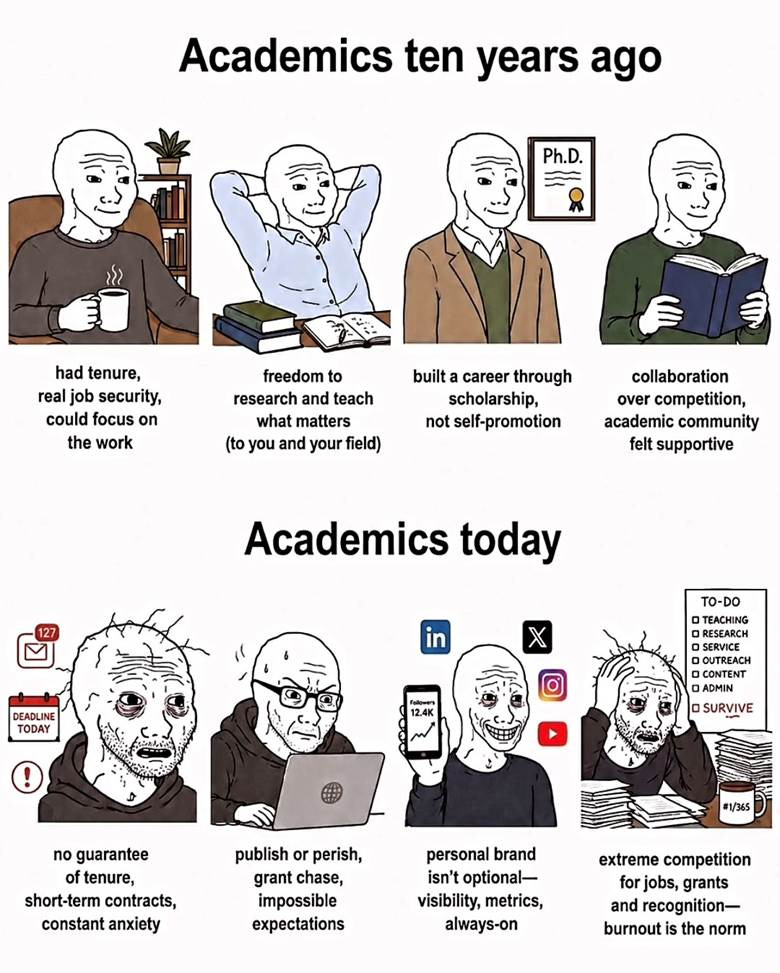
I saw this meme on Instagram yesterday. It is wrong about the timeline. Academia has been very bad since at least the 00s. It is far worse now post-pandemic than it ever was. But at least since 2000 it has been truly horrifying. Now it is a nightmare.
So then, who does say yes to letting their kid do this? Well, usually it is professors themselves. Their kids have daddy and mommy issues and want to prove to their parents that they’re just as smart as them. To quote Indiana Jones screaming at his history professor father, “What you taught me [growing up] was that I was less important to you than people who had been dead for five-hundred years in another country!”. To be a little nicer about it: professors often teach their children to value the joy of thinking, knowledge, culture, and the pursuit thereof. These are values I would love to pass onto my own children that I’ll never be able to have. Yet, there are very few places in this world where one can actually foster them. People who’ve internalized these values tend to be drawn to academic life. It seems worth it to us to put up with the indignities, the competitiveness, the financial insecurity, to pursue a life where one can live thoughtfully. And if you’ve a professor parent or two who can teach you how to navigate the competitiveness, can teach you how to fill out grant applications (might even fill them out for you), and will fund your lifestyle through the financial insecurity of a PhD, then why wouldn’t you do it? It might not even matter to you how long it takes to finish. What matters is that your work is great! What matters is that you took your time. You got to pour over every line, consider every objection. And if you fail, well, that sucks, but at least you did not bank your working-class family’s generations worth of aspirations on your risky venture when you could have just become a lawyer instead. Besides, rich kids seem to have a way of always landing on their feet. There’s no need to be stressed. You can show up every day with a smile. You can organize events on your spare time. What a good student you are; aren’t you the life of the faculty!
Now, if your parents made the mistake about engraining in you a deep love for art, for history, for thinking and learning and they’re not wealthy (or just unwilling to support you) then its time for dumpster diving or sex work. Everyone knows it. If they don’t they’re lying to themselves. Its not a coincidence that you meet significantly less cis straight male PhD students who don’t have rich parents. A PhD program is a sex work mine. A bunch of people chip away at you with pickaxes until you’re a sex worker. That’s how it is. Except none of us can admit it. Even writing this anonymously, I’m terrified. Up until a couple months ago, I’d never flat out said online that I did sex work. But I recently lost my PhD funding. My five years of funding ran out, and due to supervision difficulties, I’ve no clue how much longer my PhD will take. My option is to do even more sex work, or to try and make money off my Substack. Right now, I’m desperately trying to do the latter. If it wasn’t for the fact that this requires some openness about my personal finances, I would never have risked telling anyone about this.
You see, by and large, even the most feminist corners of academia are uncomfortable, at best, with sex work. Yes, nearly all the women students without professor parents do it. But somehow it tends to be the second and third generation academics who end up with the tenure track jobs. And the ones who did sex work before, the ones not from money, they don’t make it known. They’re smart not to. Professors love to act as though there is no power dynamic between them and their students. They don’t like the idea of having that kind of control. It is not why they got into the job. They want you to call them Bob and Janet. “Doctor” feels far too formal. While there is certainly a very formal structure, academics’ hatred of it often results in many of the issues discussed in “The Tyranny of Structurelessness”. Whether a professor is open to being your best friend or a formal ally varies wildly between them, and it is up to you to sus that out. Yet, despite the informal tones academia prefers, graduate students know that it is not so. Your supervisor can either open doors or put up obstacles. In the most extreme form, a supervisor can refuse to provide a letter of recommendation. That means your career is over. Even more mortifying (and I’ve met people this happened to), your supervisor “agrees” to write you a “letter of recommendation” and then the person who was considering hiring you pulls you aside and tells you that the letter which you never saw actually strongly discouraged hiring you.
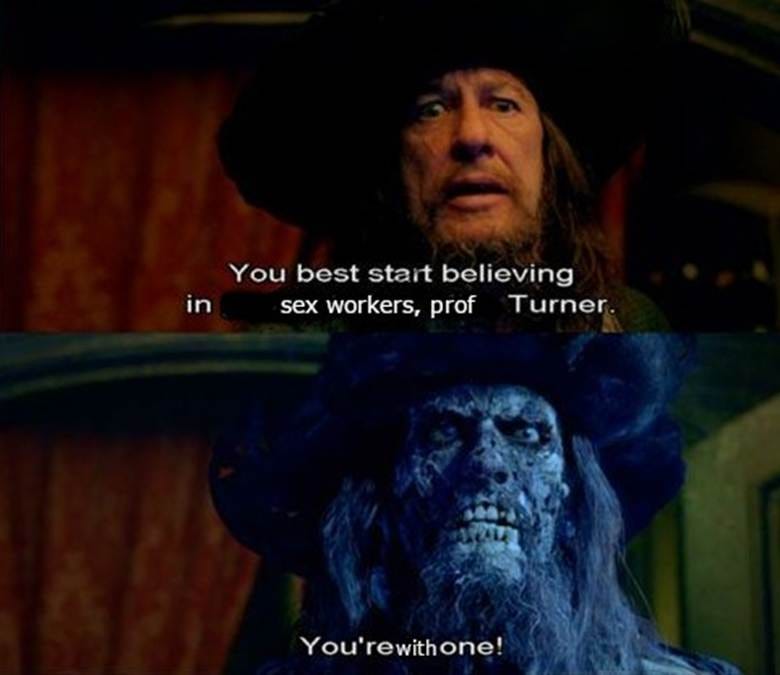
In 2019 a woman only identified as “Mistress Snow” wrote in The Chronicle of Higher Education “I Told My Mentor I was a Dominatrix: She rescinded her letters of recommendation”. Snow had been close with her mentor. She “was the sole reason” she finished her PhD. She was her “Dissertation mom.” Then, one of those contract prof summer positions fell through and “to quell her fears” Mistress Snow told her mentor that she was a sex worker. “You will lose all credibility” her mentor told her. It turns out, that this was less of a warning, and more of an informing of intent. Her mentor withdrew her letters of recommendation. Her mentor told her that Snow had “Betrayed her”. The mentor told her, “If this information comes out in any way, shape, or form, it will destroy your academics prospects.” Snow leaves it open to interpretation if her mention helped that information “come out”. She insisted “Academia and sex work are mutually exclusive,” which is rich considering Snow is a Foucault scholar. She studies a man who could frequently be found in BDSM dungeons, benefiting from sex workers. Gayle Rubin, a personal hero of mine and foundational feminist theorist, has also been very open about visiting them. Yet, when graduate students are swinging the whip, they lose their already meager chance at a career.
Several trans full-service sex workers I know through the pipeline talk about their work in Washington DC. They tell me about the massive amount of republic political staffers, congressmen, and senators that they have on their client list. Some of them openly wonder if a big part of the reason republicans are fighting against trans rights is so that they can ensure a steady supply of trans sex workers to see while their wives look the other way. Sometimes I wonder if academics are doing the same thing to sex workers. Afterall, grad school is a key part of the sex work pipeline. What were you doing at the devil’s sacrament? Or maybe it’s more “don’t ask don’t tell.” Professors know that the funding packages they offer to their students are unlivable. Professors know that you’re likely to be on the job market for four, five, six years after graduating. Maybe they’re just trying very, very hard not to think about the implications of that, of what one might do to get by. And, it would turn out, if you remind them that that is what they’re playing a part in pushing their students towards, something they conceive of as debilitating, as evil, then they would rather punish you for this honesty, for reminding them, then to help you out. Maybe they believe that they can’t help you out. Maybe they rationalize getting you out of academia as some sort of favour to you. They think that you can get a normal job. They think that you’re not in academia because normal jobs made you actively suicidal. They can’t imagine that you’re willingly selling your sexuality so that you can continue to do the think that you love more than anything else in this life. But you are. So, when they kick you to the curb, what do you do? Your life has no meaning. You’ve spent at least five years, maybe a whole decade, trying to pursue your dreams. You’re thirty-something with nothing but debt, shame, and pain. Do you keep living? If so, how? Sex work, I guess.
What I have tried to show throughout this piece is that academia needs to understand what it is doing to its graduate students. Professors need to understand their role in their students’ sex work. They need to understand that there are two classes of PhD Students: the sex workers and the family funded. They need to ensure that academic is not a role that you can only be born into. Both people and academia will suffer if it becomes a caste, and it virtually already is. Professors need to realize that the work of their poorer students will improve if they have actual security and stability. You need to realize that the reason you’re students seem so outrageously stressed is that they’re probably already doing sex work, and are often near suicidal with stress about rent, food, and how many more years they can handle being broke. If you’re an activist professor, that activism should start with your graduate students. What materially are you willing to do to help them? We’re clearly willing to do a hell of a lot to stay under your tutelage. What discussions should you be having at your faculty meetings. What sort of funding are you willing to additionally give to your students? Why does your department ‘claw back’ any additional funding students might receive, any awards they might earn?[5] Why do you make it impossible to earn more than below-poverty-line wages? Then you ask me why I spend my days at the gym staying thin? It impresses you that I’m so committed to my body? Well, now you know why. Sex work among female PhD students without professor parents is not the exception. It is very much the norm. It is up to you, not us, to fix that.
Currently, I am trying very hard to quit sex work. I want to make my money off of Substack instead. It would make my life as an academic a lot more literally survivable. I think I would be a lot less frequently actively suicidal if I didn’t have an incredibly precarious financial situation hanging over my future. So, if you enjoyed reading this, and especially if you’ve got a PhD and a stable income and you enjoyed reading this. Please consider helping me survive. I’m about thirty paying subscriber away from making back the poverty level funding I’ve run out of, and about a hundred paying subscribers away from being above the poverty line. I’ve placed a discount code right below this, consider using it!
If you are interested in sex work as a topic, I am beginning an interview series soon where I interview my friends and other sex workers about their jobs and how they think about them!
[1] I’m going to keep descriptions purposefully vague because it could harm these people if they were ever found out. Also, if you are my supervisor and you have identified me as me, please please please please do not abandon me. I am trying really hard.
[2] Please assume I am only talking about North America, I don’t want to continue to specify it as it is clunky.
[3] https://www.coursera.org/articles/how-long-does-it-take-to-get-a-phd
[4] https://www.dukeupress.edu/Depression This is a good book about even an affluent PhD student’s mental struggles.
[5] My own letter of offer makes it very clear “The amounts and sources of award funding you receive from the school will depend on whether or not you hold any other type of external funding […] Graduate students who receive funding from foreign agencies to pay for tuition, fees and/or living expenses may have different guaranteed supplemental or tuition funding amounts. Students receiving a major internal fellowship will also have different guaranteed supplement or tuition funding amounts.”
I’m curious if you’ve heard of the novel Stoner, by John Williams. It expresses a similar sentiment about academia as a kind of shelter for people who can’t survive elsewhere—“it’s for us that the University exists, for the dispossessed of the world; not for the students, not for the selfless pursuit of knowledge, not for any of the reasons you hear” (32)—but it’s also pretty reactionary in its attempt at criticizing academia. Your essay is the first that I’ve read apart from Stoner that captures this idea of academia as a refuge while criticizing its failings; I’m grateful to have read it.
As a grand-daughter of academics, this broke my heart. Definitely sharing this with my nan next time we discuss the current state of academia. Thank you so much for writing this.