

Feeding On The Cis

I no longer have any PhD funding. That means I’ve zero income from what is effectively my day job. A Pistachio Frappuccino® from Starbucks costs $7.35USD plus sales tax A subscription to my Substack costs $8USD. Because I’m a Canadian that’s $11CAD to me. If I got 200 paying subscribers, I could actually afford to like live comfortably for the first time half a decade (phd income levels are precarious at best)! Basically for the price of buying me a coffee a month you can be a shockingly large part of how I stop doing SW and get out of poverty. Please Consider subscribing!
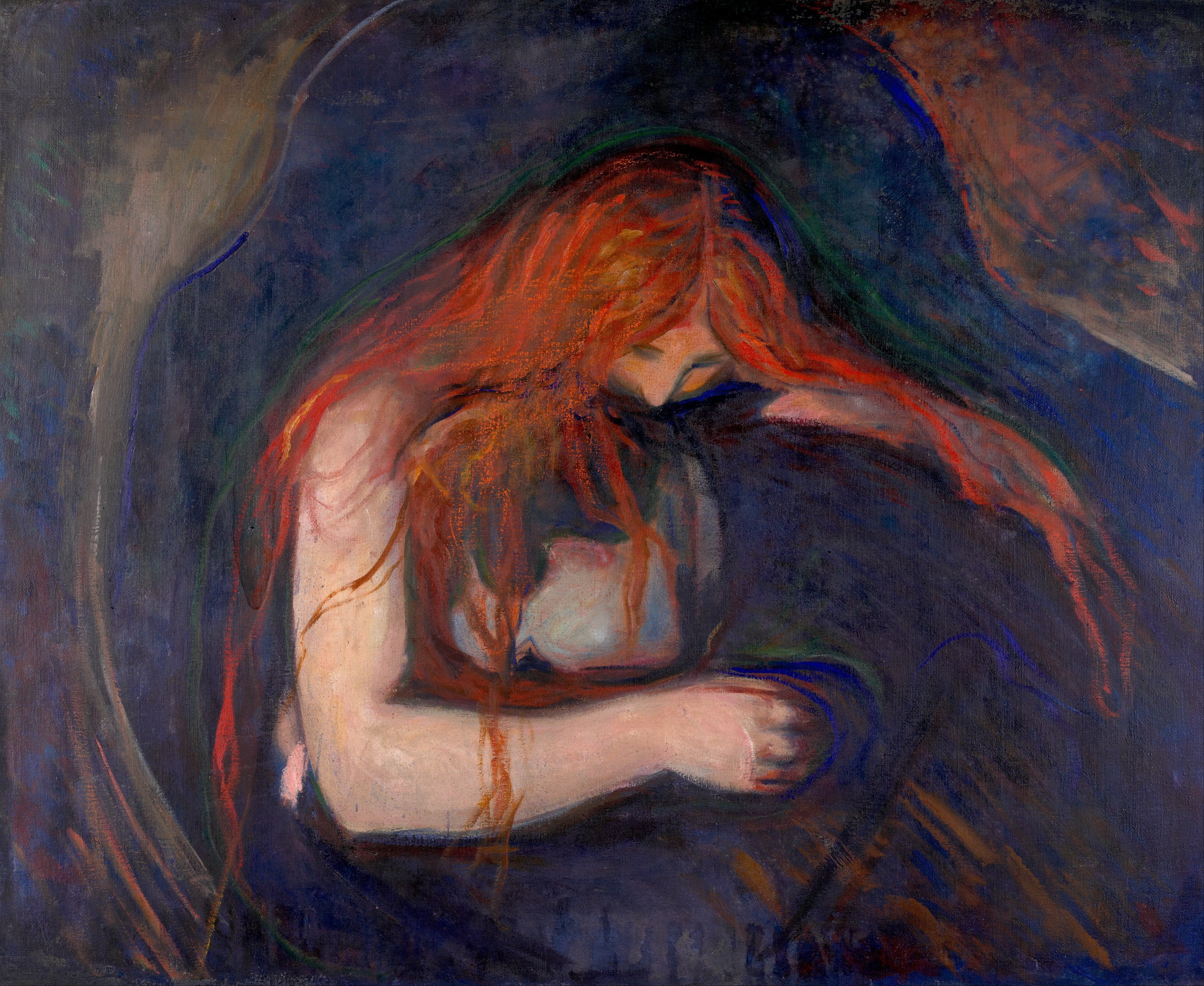
Edvard Munch, Love and Pain, 1895.
We need blood to live. All humans need blood to live. To prove that Jews are human and his bloodlust natural, Shylock says “Hath not a Jew hands, organs, dimensions, senses, affections, passions? Fed with the same food, hurt with the same weapons, subject to the same diseases, healed by the same means, warmed and cooled by the same winter and summer as a Christian is? If you prick us, do we not bleed? […] And if you wrong us, shall we not revenge?” We need blood to live. Fanon speaks in Wretched of the purification rituals of the colonized subject: “you are completely possessed. In fact, these are actually organized seances of possession and exorcism; they include vampirism, possession by djinns, by zombies, and by Legba, the famous god of the voodoo. This disintegrating of the personality, this splitting and dissolution, all this fulfills a primordial function in the organism of the colonial world.” In Anne Rice’s Interview with a Vampire Louis starts his vampiric life as the young master of a large slave plantation in colonial Louisiana. In the contemporary tv adaptation, Louis is a gay Creole man. His wealth comes from owning a New Orleans brothel. He seethes at the racism he endures. The always white, always bisexual, vampire Lestat from the same series was based on Rice herself. The 1922 German film Nosferatu, the same one that was just remade, was an antisemitic film intended to warn the audience about the dangers of Jewish immigration. In it the vampire appears, as Noah Berlatsky put it, “thin, stooped, and pale with an enormous hooked nose, a long black coat, and an odd skull cap. He was a twisted Jewish caricature – a parasitic, invasive outsider who fed on the blood of noble Christians”. In George R.R. Martin’s antebellum south novel Fevre Dream the vampire Julian buys his food at the slave auctions. He sent his buyer Sour Billy out once a month, as the “American exchange was a good place to buy a field hand or a cook, dark-skinned as you please, but for a fancy girl, one of the young dusky octaroon beauties that Julian preferred, you had to come to the French Exchange. Julian wanted beauty, insisted on beauty”. The “good guy” vampire Joshua instead, developed a potion that allowed him to play Messiah, a potion that subdues the “red thirst” of vampires, that frees them from their bloodlust, their animal nature, their hunger.
Good vampires are always the suffering ones. In 1983’s The Hunger, Susan Sarandon’s character, traumatized from her lesbian vampiric transformation, drive a knife into her own throat. In Twilight: New Moon, Edward attempts to expose himself to humanity so that other vampires will kill him. In Fevre Dream, Joshua chains himself to his prized steamboat, in hopes that the sun will kill him, after he gives into the red thirst. In Buffy, Angel is tormented by the lives he has taken, spending over a century living like an animal, feeding on rats. Convinced he is going to kill again, in the episode “Amends” Angel attempts a similar sun-suicide student to Joshua. Bram Stoker once wrote to Walt Whitman: “How sweet a thing it is for a strong healthy man with a woman’s eye and a child’s wishes to feel that he can speak to a man who can be if he wishes father, and brother and wife to his soul.” In his novel Dracula, after a sexualized encounter with the titular vampire, Mina realizes that she is “unclean”, so she begs the men to kill her should she turn.
In describing her mental state as she decided to transition Susan Stryker wrote, ““I can’t even bleed without a wound”. “Like a body without a mouth,” she felt, “I was starving in the midst of plenty. I would not let myself starve, even if what it took to open myself for a deep connectedness cut off the deepest connections I actually had.” In the original Dracula novel, the sexually excitable yet frightened Lucy finds herself sickly, bite marks on her neck. Her love, Arthur, declares that, via the almost science-fictional element of a blood transfusion, that he will offer “the last drop of blood in my body for her.” We need blood to live. We need your blood. In the novel Let The Right One In the vampire Eli, who uses she/her pronouns, who wears girls clothes, who was living as a boy until a perverted medieval vampire turned and castrated her, who is perpetually twelve years old, who has fallen in love with the burgeoning child sociopath Oskar, responds to his statement “you don’t have any clothes on” by saying “I’m sorry. Is that disgusting?”. Two pages later as she attempts to navigate the romantic feelings that have emerged between them, “but Oskar, I can’t. I’m not a girl.” But she refuses to be a guy. She understands herself, sadly, as “nothing”, as insufficiently girl. Now that she has fed, she looks more feminine than when Oskar last saw her, “Her cheeks were rounder, the dimples more pronounced”. Oskar jokes “You didn’t happen to walk past the Lover’s kiosk” as he searches for an explanation, not knowing that the blood has feminized her.
Her body wants her to be a girl. She wants to be a girl. She just doesn’t know how to navigate her anatomy. Oskar asks, “Will you go out with me”? She turns him down, but says “we can kiss, if you like.” Then, after a moment of wondering about her bodily limitations, she asks “Do you do anything in particular with someone you’re going out with?” When Oskar says no, she agrees to date him. Later, the sadistic Oskar demands that Eli enter a room without him inviting her in. Her eyes sink into her sockets and fill “with blood flowing out, running along the bridge of her nose over her lips into her mouth, where more blood was coming out […] She was bleeding out of all the pores in her body”. He waits until the last moment to save her. She has to change her clothes. Perversely, Oskar stares as the monster changes “The small nipples looked almost black against her pale white skin. Her upper body was slender, straight, and without much in the way of contours. Only the ribs stood out clearly in the sharp overhead light. Her thin arms and legs appeared unnaturally long the way they grew out of her body: a young sapling covered with human skin. Between the legs she had…nothing. No slit, no penis. Just a smooth surface.” The description is cruel and pointless. We already know, Oskar already knows, has already, via memory transfer, lived Eli’s castration. He knows it all. He felt it from her point of view. Now he looks on her from his own. He sees a monster that needs blood. Earlier, when he first finds out he thinks that “he could somehow accept that she was a vampire, but the idea that she was somehow a boy, that could be…harder.” The author, John Ajvide Lindqvist is using he/him for her by the end of the book. In a follow-up short story we learn that she has turned Oskar so that they can live together as a couple. Presumably she has not castrated him. But now he needs blood. But, unlike her, he likes harming. He can give her what she needs. He can give her the blood of others because she did not act on her need for his blood.
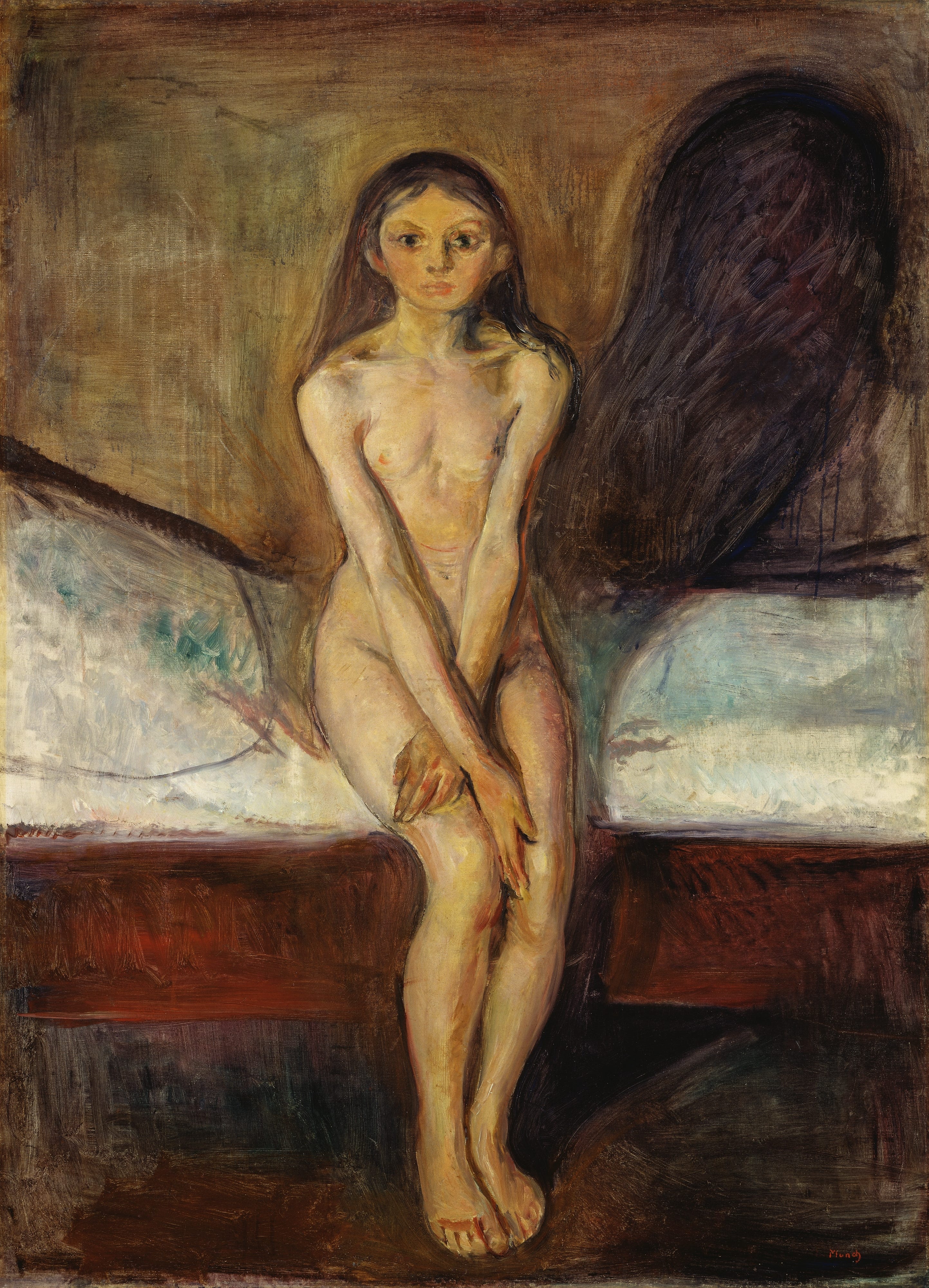
Edvard Munch, Puberty, 1894-95.
The horror of vampires is the horror of the need of others. It asks the presumably straight, presumably white, presumably male reader to imagine that Jews, Black people, women, might all want life. Life is to live, but life is also to live well, fulfilled. The evil vampire wants what you white, cishet men have. It wants comfort, food, and orgasms. It wants your women. It wants your fancy bourgeois dress. The good vampire, by comparison, is happy merely living. It will feast on garbage and on rats. It will abstain. It might even kill itself. It will be second class. It will be animal. The horror of vampires is that they confront cis, heterosexual whiteness with intelligent conversation, the enlightenment ideal that signals a right to humanity, to personhood. The horror of vampires is that you cannot think of a good reason why it doesn’t deserve what you have, other than that it would have to take it from you, or others like you. The implicit solution to all of this is that it is soulless and that the maths are bad. For the vampire to live well, it must end the lives of many. One life is not worth more than one life. That is the claim. Except, of course, that this is the situation every denizen of the First World finds themselves in. Our lives feast on the lives of those in the Global South. Regardless of who we are, we feast. Even in poverty, in transness, in Jewishness, in brownness, in Blackness, we feast. We are already living the vampire’s life.
In her essay, “My Words to Victor Frankenstein above the Village of Chamounix: Performing Transgender Rage”, from which I have already quoted, Susan Stryker uses the Frankenstein story to speak of the existential horrors that confront the medically transexualized body. Yet in doing so she renders us metaphorically male. Frankenstein’s monster was male. He also usurped maleness by an existence that he had no say in embodying. But there was no question of femaleness. The bride that various 20th and 21st century movies provide the monster is feminized, prettier. The monster is trapped in his maleness. He is giant, hideous, sewn together in a functional disfigurement. Perhaps because I am pretty, or perhaps because I am satisfied with my surgical intervention, or perhaps because I am a girl, or maybe just because I am me, the vampire makes more sense to me as the central trans monster. I reject Stryker’s claim that “Transsexual monstrosity […] can never claim quite so secure a means of resistance because of the inability of language to represent the transgendered subject’s movement over time between stably gendered positions in a linguistic structure”. I’m unsympathetic to this claim. I think language has done a fine job of representing transition. I feel as though I speak from as stable a position as any living being. Like any living being, I need blood. Stryker understands this when she writes, “Rage colors me as it presses in through the pores of my skin, soaking in until it becomes the blood that courses through my beating heart. It is a rage bred by the necessity of existing in external circumstances against my survival.”
Like Frankenstein’s monster, the vampire is not self-made. It relies on intervention. But, the vampire is self-sustaining. Frankenstein’s monster need not do anything that would render him a monster to live. Men rarely do. Vampires need blood. If we don’t have blood our feminine beauty leaves us. Then we die. Or, in some variations, we become a nearly lifeless husk, one that could still be revived by your blood. The need for the blood of the ‘normal’ people, the cishet whites, is shared by all oppressed people insofar as blood means that which gives and sustains life. However, I feel the vampire is uniquely well suited to transness in how it attains blood. It looks just like everyone else. It comes out at night. It seduces. It’s sexual. Perhaps it is the pure embodiment of taboo sexuality. It feasts beautifully on the prey it has seduced, tricked, cornered by looking like a prettier version of its prey. The beauty is a lie. The beauty requires your blood. And if you’re not careful, if some part of you wants it too much, it may deliver onto you a ‘fate worse than death’. It may make you a member of its own nightwalking tribe. It many convert you to the blood—the blood it will take from you, and the blood you will live to take. Do you need blood?
It is not just that the vampire embodies the fears of cis people about trans people. There is something true to it. I need what cis people have to live. I am frequently denied it. I frequently have to pass myself off as one of them to get it, to survive. A sharp little fang pierces flesh, injects venom (okay, it’s HRT) into me weekly. I need it to live. But I need more too. I need the womanhood society tries to deny me. I must adopt an air of sophistication, intelligence and charm, to convince the cis to give me what I need to survive: a job, an apartment, human dignity, enough money for food. I must make myself more beautiful than the average cis woman, put more work in than her to that beauty, or risk my sunken eyes revealing that I am not quite like her. I want to move in the world without evoking fear. No one should wish to scream or flee when I walk into the club. I must captivate the cis. If I cannot captivate, I must move unnoticed. I must blend in. Harsh light might give me away. I must conceal my true nature or else the world would turn against me. I am owed life, but the cis seem not to agree. I must be allowed to feed, to live. I need blood, just like you. Give me your blood. I promise I won’t take all of it. But you have more than enough. Rich world of the cis, you have in abundance what you refuse to give me: dignified life. If you admit a vampire needs life, is entitled to life, perhaps she will not have to pretend that she is not a vampire. If you admit that vampires are people, then vampires will stop pretending to be people. We will simply be people. All we ask is for a little life.
Acknowledgements:
The following people are “founding member” paid subscribers. That is, they are people who decided that my work was not only worth supporting, but that they could afford to pay more than the rate I was asking. On both a financial and emotional level these people mean an incredible amount to me. I screamed aloud the first time anyone ever became one. I cried when a second person did. The least I can do is thank each one individually. They give me hope. Thank you to:
X Valentine, T S, i.m., and Rachel K.
You have filled me with joy, and helped make this writing possible.